
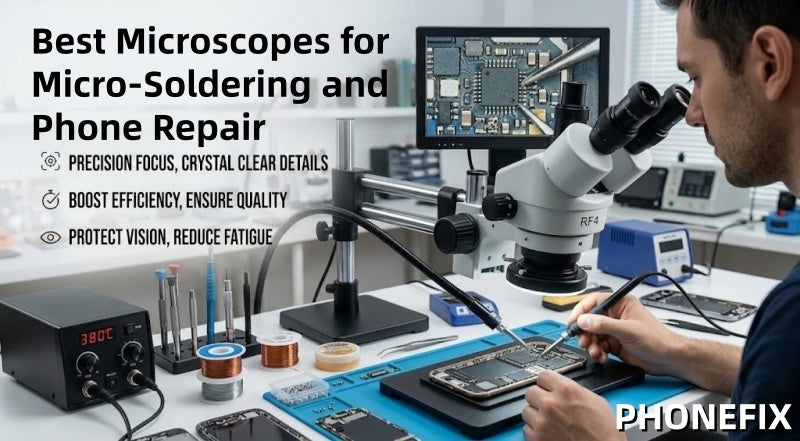
In mobile phone repair and precision soldering, working at the micron level is crucial for ensuring repair quality. Since the naked eye can't handle such tiny components, a microscope is essential for precision. Choosing the right microscope boosts efficiency and guarantees the reliability of each solder joint. Phonefix will outline key factors to consider when selecting an electronics repair microscope to help you match the perfect equipment to your needs.
I. The Indispensability of Microscopes in Electronics Repair
In mobile phone motherboard repair—tasks such as replacing power ICs, reballing CPUs, repairing lifted pads, or performing jumper wire repairs—all require execution with micron-level precision. The role of a HD microscope is primarily manifested in the following three dimensions:
1. Extreme Precision and Detail Capture
Micro-soldering requires technicians to perform extremely precise operations on tiny solder joints, capacitors, and resistors. Through physical magnification, a microscope transforms areas that would otherwise appear blurry into sharp, crystal-clear images. It enables technicians to quickly identify hidden defects, such as:
· Dry Joints and Cold Solder Joints: Connections that appear solid on the surface but suffer from poor electrical contact.
· Solder Bridges (Short Circuits): Unintentional bridges of solder forming between two adjacent pads.
· Micro-cracks: Minute fractures within the PCB layers caused by accidental drops or physical impact.

2. Significant Enhancement of Repair Efficiency
"Seeing clearly is half the battle." With the aid of a microscope, technicians can accurately pinpoint the exact location of a fault on the very first attempt, thereby minimizing the secondary damage—such as unnecessary disassembly and repetitive heating—that can be inflicted upon the motherboard. A high-definition field of view accelerates the troubleshooting process, significantly boosting a technician's daily repair capacity.
3. Alleviating Occupational Health Strain
Spending prolonged periods hunched over to stare at tiny components can lead to severe eye strain and cervical spine issues. Professional repair microscopes—particularly those featuring ergonomically designed stands and eyepiece systems—allow technicians to maintain a natural, upright sitting posture. By providing clear, magnified images, these tools reduce the visual intensity required for the task, thereby helping to extend a technician's professional career longevity.
II. Main Types: Pros and Cons
The mainstream repair microscopes currently available on the market fall into three main categories, each suited to specific application scenarios:
1. Stereo Microscopes — The Top Choice for Professional Soldering
Stereo microscopes utilize a dual-optical-path design to provide images with depth perception (a 3D effect).
· Pros: Zero-latency optical imaging and exceptional realism. This is crucial for hand-eye coordination during soldering, allowing users to accurately judge the distance between the soldering iron tip or tweezers and the solder pad.
· Recommended Scenarios: High-difficulty IC soldering, jumper wiring, and component placement/alignment.
2. Digital Microscopes — An Essential Tool for Teaching and Demonstration
Unlike traditional models, these microscopes do not require viewing through eyepieces; instead, they transmit images directly to a display screen.
· Pros: Ergonomically friendly (no need to hunch over); convenient for multiple people to view simultaneously; capable of recording high-definition instructional videos and capturing photos for documentation.
· Cons: Budget models may suffer from image latency and lack 3D depth perception, requiring a certain period of adjustment to accurately position tools during precision soldering tasks.
3. Trinocular Stereo Microscopes — The All-Rounder
This is currently the standard equipment found in professional repair shops. Building upon the binocular design, it features a third optical port specifically for mounting a camera.
· Pros: Combines the benefits of optical stereo vision with digital recording capabilities. Technicians perform operations while looking through the eyepieces, while the screen simultaneously displays the live workflow—facilitating demonstrations for clients or collaboration among team members.

III. Five Key Technical Specifications for Choosing a Microscope
When selecting a microscope, do not blindly chase after the highest magnification; the following parameters are actually more critical in determining your practical operational experience:
1. Magnification
For mobile phone repair, the most commonly used effective magnification range is 7x to 45x. Excessively high magnification (e.g., above 100x) results in an extremely narrow field of view and insufficient lighting, making it impractical for most tasks. Typically, 7x–10x is used for general inspection, while 20x–30x is considered the "sweet spot" for soldering work.
2. Working Distance
This refers to the vertical distance between the bottom of the objective lens and the circuit board. For soldering applications, a working distance of at least 100mm is required to provide sufficient clearance. If the working distance is too short, the soldering iron tip or hot air nozzle may collide with the microscope due to a lack of clearance, or potentially cause heat damage to the lens. By installing a 0.5x Barlow lens, you can effectively double the working distance.
3. Field of View
A larger field of view means you can observe a wider area without frequently having to reposition the motherboard, thereby improving workflow continuity.
4. Stand Type
· Standard Base: Space-saving, but offers limited flexibility.
· Dual-Arm Boom Stand: The industry standard. It allows you to position the microscope over the center of your workbench when needed, and swing it out of the way when not in use—making it ideal for working on large tablets or for multitasking operations.
5. Illumination System
A powerful LED ring light is the standard inclusion; it provides uniform, shadow-free lighting that prevents harsh glare from reflecting off metal solder joints.
IV. Recommended Top-Tier Micro-Soldering Microscope Models
Based on feedback from the global repair community and sales data from Phonefix, the following microscope models represent the current pinnacle of value for money and professional-grade performance:
1. YCS Mr.Yang 85 Ultra HD Microscope
Widely recognized as the "Gold Standard" for professional repair shops.
· Features: Offers 6.3x–68x continuous zoom, making it suitable for the detailed inspection and repair of electronic components on PCBs.
· Reviews: Extremely robust and durable, with exceptional optical clarity—built to withstand intensive, all-day operation.
2. RF4 6.5X–55X Trinocular Stereo Microscope
RF4 has rapidly gained prominence within the electronics repair community in recent years.
· Features: Compared to traditional 45x models, its 55x maximum zoom capability offers a finer level of observational detail. Equipped with a 0.48x Pro CTV adapter, it enables synchronized zooming between the eyepieces and the camera feed—effectively resolving the common "focus synchronization" issue found in traditional trinocular microscopes.

3. Mechanic Mic3 or Hayear Series
For independent workshops or individuals with a limited budget who still demand professional-grade performance, these brands offer excellent options.
· Features: Equipped with WF10X/25mm high-definition wide-angle eyepieces, offering an expansive field of view with minimal edge distortion. These typically come as complete kits (including the microscope, camera, light source, and stand), ready for immediate use right out of the box.
4. Andonstar AD409 Series
If you prefer performing repairs while viewing a screen display:
· Features: Boasts a large 10.1-inch screen with HDMI output support and 4K resolution. It significantly alleviates neck strain, making it ideal for large-scale PCB inspections and simple soldering tasks.
V. How to Make the Final Choice Based on Your Specific Needs?
· Beginners / Limited Budget: Opt for trinocular kits from brands like Mechanic or Hayear. They are affordably priced, yet their performance is sufficient to handle 95% of common mobile phone repair tasks.
· Professional / Advanced Technicians: We recommend investing in the AmScope or RF4 series. Their high-definition optical systems can significantly reduce visual fatigue during prolonged work sessions.
· Educators / Content Creators: You must select a trinocular microscope equipped with a 4K camera interface. High-quality video output is crucial for engaging your audience and attracting clients.
· Space-Constrained Environments: Consider models featuring a desktop clamp stand to save valuable workspace otherwise occupied by a traditional base stand.
For every repair engineer, selecting the right microscope undoubtedly represents a significant professional investment. As a leading provider of repair solutions in the industry, China Phonefix not only offers the aforementioned high-performance microscopes but is also dedicated to providing a comprehensive range of professional micro-soldering tools—spanning everything from precision soldering irons and hot air guns to various specialized components for chip-level repairs.


