
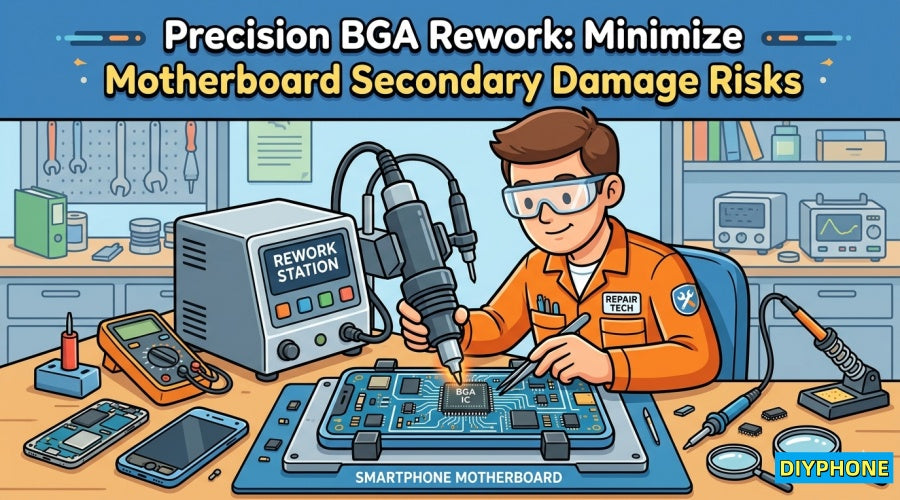
In the field of contemporary smartphone repair, the prevalence of BGA packaging technology has doubled the difficulty of motherboard integration repair. Core components such as the CPU, RAM, baseband, and power management chips are connected to the PCB via a bottom array of solder balls. This article will demonstrate how the BGA rework station has evolved from an auxiliary tool to the cornerstone of the repair workbench.

I. Tool Preparation and Fault Analysis
Before performing BGA-level repairs, a complete tool chain is the prerequisite for ensuring success.
1. Precision Tools
· BGA Rework Station: Features upper and lower zone temperature control and a preheating stage, supporting multi-stage temperature curve settings.
· Infrared Thermal Camera: Used for fault localization before repair, quickly locking onto short circuits or chips with abnormal heat on the motherboard.
· Electronic Microscope: Used to observe solder joint status, check trace integrity during underfill removal, and verify alignment after soldering.
2. Consumables and Small Tools
· Solder Paste: Select solder with the appropriate melting point based on the chip’s heat resistance.
· High-Precision Reballing Stencils: Matches the specific hole positions of the chip model.
· Desoldering Wick and Flux Remover: Used for pad cleaning and removing residual flux.
· Ceramic Surgical Blades: Used for delicate removal of underfill around the chip.
3. Typical Fault Analysis
· Analysis: Frequent restarts, blue screens, or freezing at the Logo interface often point to "cold" solder joints or failure of the Application Processor (CPU) or RAM.
· Causes:
a. Drops leading to high instantaneous impact force, causing the bottom solder balls to fracture.
b. Long-term high-load operation, where repeated thermal expansion and contraction lead to solder joint fatigue.
· Repair Logic:
Perform "Reballing" or replacement of core components via the BGA rework station. Since mobile PCBs often use a stacked design (PoP packaging), the station's constant temperature zone heating must be used to prevent bridging the bottom CPU solder joints while removing the top-layer memory.

II. Technical Advantages of BGA Rework Stations
1. Thermal Stress Protection for Multi-layer PCBs
Smartphone motherboards are typically 8-12 layer High-Density Interconnect (HDI) boards. The BGA rework station uses a large-area infrared preheating zone at the bottom to reduce the temperature gradient between the front and back of the board, effectively preventing PCB warping or delamination (popcorning) under localized high temperatures.
2. Non-destructive Processing of Underfilled Chips
Modern smartphones use hard black or transparent underfill around the CPU to enhance structural strength.
· Operation Point: Use the stable, controlled hot air of the BGA Rework Station to soften the underfill to a specific temperature range (usually 150°C-180°C). At this point, using a ceramic blade to clean residual glue avoids scratching motherboard traces or knocking off tiny capacitors.
3. Non-contact Soldering and Precision Temperature Control
Compared to the instability of manual hot air gun operation, a BGA rework station can control temperature variance within ±1°C. Non-contact hot air circulation ensures the chip does not physically shift during the melting process. Coupled with automatic desoldering functions, this significantly improves the yield rate for baseband repairs and PMIC replacements.

III. BGA Rework Repair Steps
Taking the replacement of a Power Management IC (PMIC) as an example, the standard process is as follows:
Step 1. Preheating and Removal
Secure the cleaned motherboard onto the BGA rework station bracket, select the nozzle corresponding to the chip size, and call up the "PMIC Removal Curve." Preheat the bottom to 120°C, and ramp up the top hot air according to the curve to the solder melting point. Use a vacuum pickup pen to automatically lift the chip.
Step 2. Pad Treatment and Cleaning
Apply a small amount of medium-temperature flux paste to the motherboard pads. Use a soldering iron with desoldering wick to level the pads using the "drag soldering" method, ensuring no residual bumps. Inspect for dropped pads or solder bridging under a microscope.
Step 3. Chip Reballing
Place the cleaned new chip into the reballing stencil, apply solder paste evenly, and use a hot air gun at low speed to form the solder balls. Precisely align and place the reballed chip onto the motherboard pads. Start the "Reflow Soldering Curve" and observe the chip for a natural "self-alignment" movement (due to surface tension). Complete the repair after cooling.
IV. Summary
More than a mere heating machine, the BGA rework station is a precision Mobile repair tool for resolving physical connection failures in smartphone integrated circuits. It significantly reduces the risk of secondary damage. For precision repair businesses pursuing high success rates, mastering its operation has become a key indicator of technical proficiency.


