
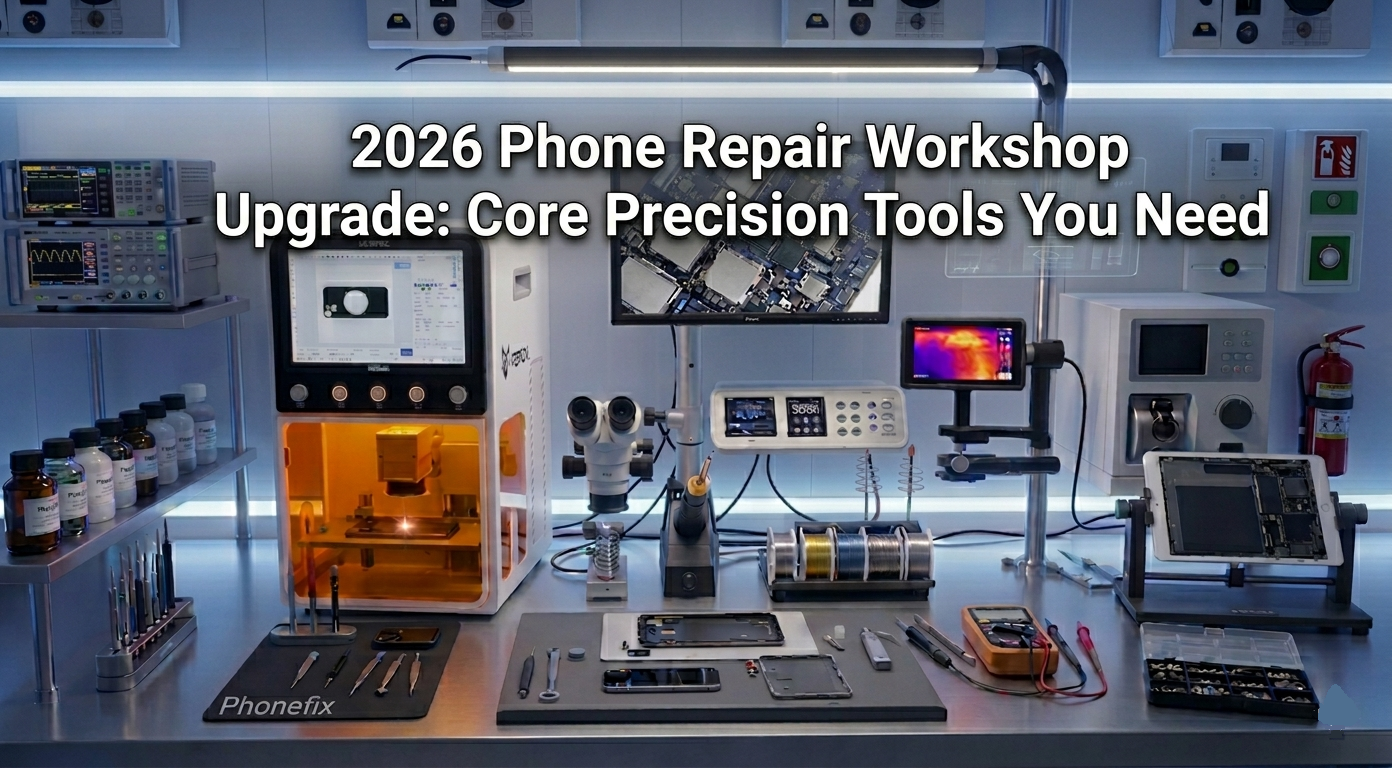
The phone repair industry in 2026 faces a clear turning point. Early-stage 2nm processors, foldable displays, and hardware-level encryption have made devices extremely fragile and complex. Traditional methods — forceful prying, hot air guesswork, and messy workbenches — often cause irreversible damage. To stay competitive, workshops need a systematic upgrade across four areas: disassembly, diagnosis, soldering, and workspace management — and that upgrade starts with the right Phone Repair Tools.
Before diving into high-end upgrades, every phone repair workshop must secure a solid foundation of basic precision tools. These items are non-negotiable for daily efficiency and quality:
· Screwdriver sets (hardened bits, magnetic swivel): avoid stripped screws.
· ESD-safe tweezers, prying tools, suction cups, spudgers: safe opening and cable handling.
· Magnetic screw mat & cutting mat: organized workspace.
· Digital multimeter & adjustable bench power supply: basic electrical diagnosis.
· Trinocular digital microscope (7x–45x): inspect micro-soldering and BGA balls.
· Hot air rework station: component removal and soldering.
Each tool addresses a specific failure point. Skipping the basics makes advanced upgrades ineffective.

I. Intelligent Disassembly: Moving from Force to Non-Contact Techniques
· The UV Laser Machine has replaced manual chisels for iPhone screen separation, phone back glass removal, and so on — all without damaging the phone components. Examples are the REFOX RK10, the TBK 958ZP, and the TBK 958Z.
· Precision heating platforms with adjustable temperature profiles help separate foldable screens without stressing the hinge or tearing flexible OLED layers.
· Non-contact screwdrivers with torque limiting prevent thread stripping on tiny screws used in 2nm-class logic boards.
· The goal is to touch the device only when necessary, preserving component integrity.
II. Vision and Diagnosis: Giving Repair Technicians “Fiery Eyes”
· With dual-light imaging and a 256×192 resolution, the ShortCam III thermal imager quickly detects tiny leakages. When paired with analysis software, it compares live thermal data against standard circuit signatures to locate short circuits in seconds.
· High-magnification digital microscopes with autofocus and measurement tools allow visual inspection of micro-soldering work and crack detection on BGA balls.
· Multilayer board fault locators (time-domain reflectometers) help find internal trace breaks without blind drilling.
· These tools turn diagnosis from guesswork into a visual, data-driven process.
III. Micro-Soldering and Data Repair: Rebuilding Core Competitiveness
· Fine-pitch BGA and 2nm chips require a soldering station with linear temperature control and instant thermal recovery. The AIFEN A902 Pro Soldering Station provides stable tip temperature even on large ground planes, preventing pad lifting and cold joints.
· Encryption-aware programmers are essential for restoring full functionality. The JCID U70 Gen2 UFS Programmer handles battery pairing, True Tone, and Face ID recalibration after part replacement without bypassing security.
· Precision CNC Grinding Machine for non-destructive chip removal: For board-level iCloud unlocking or chip transplantation (CPU, baseband, NAND, Wi-Fi, FPC, etc.), a CNC grinder removes chip encapsulation layer by layer with micron-level depth control, avoiding PCB warping or pad damage caused by hot air. This enables reliable hardware-based iCloud unlock. Examples: EM03 Grinding Machine, Xwitzeal Q1 CNC Grinder.
· Chip transplant (board-swapping) and trace repair become viable, high-margin services when supported by these tools.
· High-magnification measuring microscope: Real-time inspection of BGA ball alignment, pad condition, and fine-pitch chip placement and soldering quality, preventing cold joints and bridges.

IV. Digital Management and Cleanroom Environment
· An ESD-safe area with a laminar flow bench (Class 100,000 is sufficient for most repairs) protects sensitive flex cables and exposed chips from static and dust.
· Magnetic screw mats and labelled part trays eliminate lost screws and misplaced connectors, reducing rework.
· A simple digital log (repair history, parts inventory, tool calibration dates) improves consistency and helps track repeated issues.
· A clean, organised workspace not only reduces errors but also builds customer trust.
V. Optional Advanced Service: Foldable Display Refurbishment
Beyond the four core upgrades above, workshops aiming for premium service segments can consider foldable display refurbishment as a high-margin optional specialty. Foldable devices (e.g., Samsung Galaxy Z Fold 7, Huawei Mate X6, Google Pixel Fold 2) use ultra-thin glass (UTG) just 30–50 µm thick, which is prone to crease cracks and delamination. Refurbishing instead of replacing a foldable screen saves customers 60–70 % of the cost while delivering excellent margins.
Essential tools for this service:
· Dedicated foldable screen separator with adjustable curvature and vacuum clamping – lifts UTG without cracking.
· Ultra-thin OCA laminator with roller pressure calibration – applies new adhesive bubble-free across the crease.
· Vacuum Bubble Remover (e.g., TBK-808A, RMB-5MAX) – eliminates residual air pockets in multi-layer foldable displays.
· Flex cable re-bonding fixture – allows micro-soldering of torn traces on flexible copper-clad laminate (FCCL).
Adding foldable refurbishment requires additional investment, but for workshops ready to differentiate themselves, it is a lucrative next step.
Precision tools are not a marketing gimmick. They are a practical response to rising device complexity. By focusing on non-contact disassembly, stable micro-soldering, encryption-aware programming, and a clean digital workspace — with quality tools from a trusted supplier like Phonefix — repair workshops can meet the demands of 2026 hardware without unnecessary hype or expense.


