
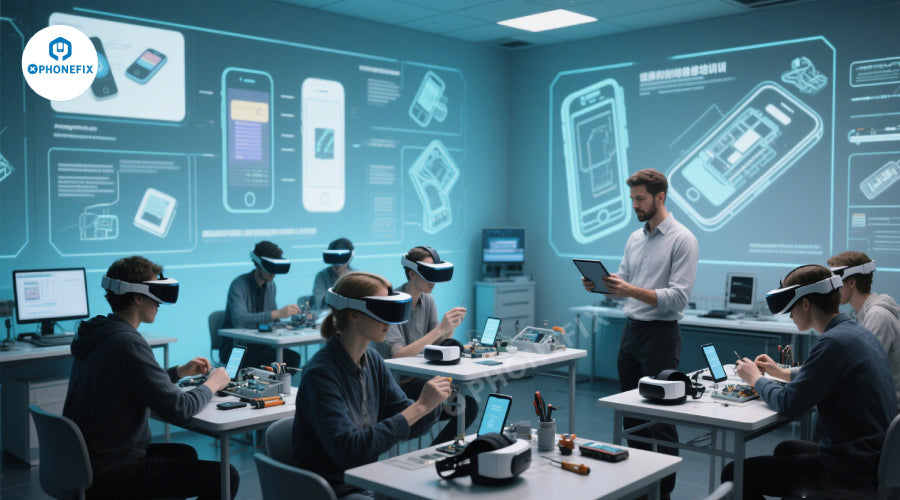
Mobile phones have long become a necessity in life, and the demand for repairs is increasing day by day. What trends will mobile phone repairs have in the future? What practical phone repair tools will appear? Next, let Phonefix explain the future trends and tools of mobile phone repairs to everyone, and explore this field full of changes and opportunities together.
Future Trends:
1. Technological innovation and specialization:
Popularization of non-destructive repair technology: In the future, non-destructive repair technology will be more widely used. In scenarios such as iPhone screen repair, repairs can be completed without damaging other parts of the mobile phone, reducing repair costs and risks.
Introduction of automated equipment: The utilization rate of automated equipment will increase. For example, automatic detection equipment can quickly and accurately locate mobile phone faults, improve repair efficiency, and reduce manual detection errors.
Development of intelligent diagnosis system: With the help of Internet of Things, big data and artificial intelligence technology, intelligent diagnosis system can predict faults in advance by analyzing mobile phone usage data and fault phenomena, and provide maintenance personnel with accurate fault diagnosis reports to help fast repairs.

2. Service model innovation:
Online platform becomes mainstream: The proportion of online channel sales will increase significantly. Consumers will be more inclined to make appointments for repairs, consult faults and purchase accessories through online platforms, while offline stores will focus on high-end services and accessories sales.
The rise of personalized customized services: Through big data analysis of consumer needs, customized repair solutions are provided for different users, such as personalized repair packages for specific mobile phone models or user usage habits.
On-site repair service expansion: As a convenient after-sales service method, on-site repair service for mobile phones is gradually gaining favor among consumers. It is expected that more companies will provide on-site repair services in the future to expand the service coverage.
3. Optimization of accessories supply chain:
Strengthen cooperation with manufacturers and suppliers: The mobile phone repair industry will strengthen cooperation with mobile phone manufacturers and iPhone accessories suppliers to establish a more stable and efficient accessories supply chain, ensure the quality and timeliness of accessories, and reduce procurement costs.
Popularization of intelligent warehouse management system: Repair companies will widely adopt intelligent warehouse management systems to achieve accurate management of accessories inventory, reduce inventory costs, and improve the efficiency of accessories in and out of the warehouse.

4. Industry standardization and normalization:
The government and industry associations will strengthen supervision of the mobile phone repair industry and promote the industry to gradually achieve standardization and normalization, including repair technology standards, service quality standards, price specifications, etc., to protect consumer rights and enhance the overall image of the industry.
5. Enhanced environmental awareness:
With the popularization of environmental protection concepts, the mobile phone repair industry will pay more attention to environmental protection. Companies will use more recyclable materials to manufacture parts, promote second-hand mobile phone repair business, reduce the generation of electronic waste, and reduce the impact on the environment.
6. More cross-border cooperation:
Mobile phone repair companies may cooperate with insurance companies to launch extended warranty plans, etc., and may also conduct cross-border cooperation with mobile phone manufacturers, operators, e-commerce platforms, etc., integrate resources, expand business scope, and provide consumers with more comprehensive services.
Possible tools:
Intelligent diagnostic tools: AI fault detectors can quickly analyze software and hardware data and accurately locate faults, such as quickly determining the root cause of mobile phone heating and fast power consumption. IoT intelligent diagnostic systems can remotely monitor the status of mobile phones in real time, generate fault reports based on sensor data, and accurately point out antenna, chip or interference problems when the signal is unstable.
Precision repair tools: Ultra-fine nano-level welding equipment realizes nano-level welding, which helps to repair the iPhone motherboard of tiny chip pins and circuits. Atomic chip repair tools can repair chip structures at the atomic level and save chips damaged by overheating.

Automated repair tools: Fully automatic mobile phone disassembly robots use robotic arms and visual recognition systems to automatically disassemble according to mobile phone models, which is fast and safe. 3D printing mobile phone accessories manufacturing machines can quickly print adapted or even personalized mobile phone accessories based on model data.
Remote collaboration tools: 5G+AR remote repair glasses allow experts and on-site personnel to "face to face" and guide repairs with the help of AR annotations. The intelligent remote collaboration platform integrates multiple functions to achieve fault data sharing, expert remote guidance, and even running equipment maintenance.
The future of mobile phone repair is moving towards a new journey of intelligence and efficiency with the development of technology. The above summary is just the tip of the iceberg. If you have other questions, insights, or want to know more about mobile phone repair, please feel free to discuss with Phonefix.


