
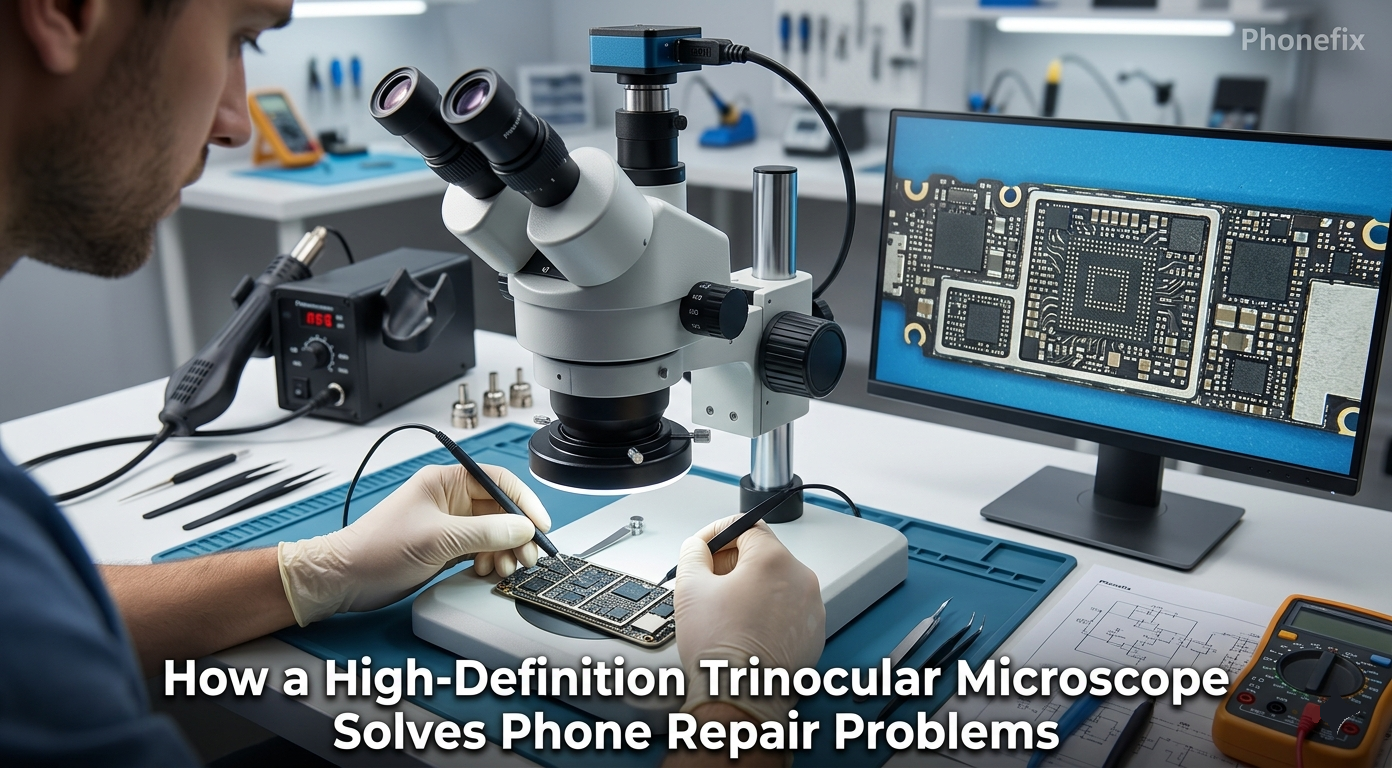
Modern smartphones are marvels of extreme miniaturization. As internal components shrink to sub-millimeter scales, traditional magnification tools inevitably fall short, leaving technicians blind to critical, microscopic defects. Enter the high-definition trinocular microscope—now an indispensable cornerstone of the micro-soldering workbench. By bridging the gap between human vision and micro-engineering, this tool has fundamentally transformed how technicians diagnose, execute, and master intricate motherboard repairs.

I. The “Visual Blind Spots” in Modern Board-Level Repair
Mobile phone repair has firmly entered the micro-soldering era. Logic boards are densely populated with 0201 passive components (0.6 mm x 0.3 mm) and even 01005 packages (0.4 mm x 0.2 mm). Compounding this complexity are heavy CPU underfills and multi-layered, stacked PCB architectures that bury vital traces beneath layers of fiberglass and copper. Under conventional loupes or monocular digital microscopes, several high-stakes procedures remain obscured by persistent "blind spots":
· Micro-Jumpering (Flying Wires): Attaching jumper wires as thin as 0.02 mm to ripped or missing pads requires flawless execution. Without true depth perception, technicians cannot reliably detect microscopic gaps between the wire and the pad, resulting in frustrating intermittent connections or cold solder joints.
· Pad Reconstruction (Dotting): When a pad is torn from the PCB, the technician must scrape back the solder mask to expose the underlying copper trace and rebuild the pad from scratch. This demands extreme optical magnification to isolate individual copper fibers, coupled with ample working distance to maneuver a micro-soldering iron.
· Liquid Damage & Sub-Surface Corrosion: Corrosion frequently creeps beneath the solder mask or penetrates inner board layers. Standard microscopes lacking specialized illumination fail to differentiate between a benign surface stain and a catastrophic hairline crack in a trace.
· Stacked PCB Reballing: Premium devices (such as modern iPhones) utilize a sandwiched motherboard design where two or more PCBs are laminated together. Aligning thousands of microscopic solder balls between these layers requires precise stereo vision. A flat, monocular view makes it impossible to judge whether a solder ball is perfectly seated or hovering blindly above its target.
Each of these visual blind spots leads to misdiagnosis, wasted bench time, and all too often, irreversible thermal or mechanical damage to expensive application processors and baseband chips.
II. The Core Technical Advantages of Trinocular Optics
A Trinocular Stereo Microscope splits light into three distinct optical paths: two dedicated to the user’s eyes (binocular stereoscopic view) and a third dedicated to an imaging sensor. For mobile repair, this configuration delivers advantages that go far beyond simple magnification.
1. High-Definition Optics: Revealing the Invisible
Premium trinocular systems utilize high-resolution apochromatic objectives that eliminate
chromatic and spherical aberrations. Copper traces, solder bridges, and micro-cracks are rendered with flawless color accuracy and razor-sharp contrast. Boasting optical resolutions down to the 0.5 to 10-micron range, technicians can instantly spot sub-surface BGA pad contamination or microscopic solder whiskers. Unlike cheap, lagging digital microscopes, optical trinocular systems offer zero-latency, real-time visual feedback.
2. Binocular Stereo Vision: Critical Depth Perception
The dual optical paths mimic human binocular vision, generating a true three-dimensional image. This spatial awareness allows technicians to accurately judge vertical distances-such as confirming a jumper wire is physically touching a pad before applying solder. Monocular systems distort perspective; what appears perfectly aligned from a top-down view may actually feature a 20-micron vertical gap. Stereo vision eliminates this guesswork, proving critical during delicate BGA alignment and stubborn CPU underfill removal.
3. The Third Port: Seamless Documentation & Collaboration
The dedicated third optical port routes a live, high-resolution feed to an external monitor or PC via HDMI or USB. This transforms a traditionally isolated repair into a highly collaborative, multi-functional process:
· Process Recording: Intricate procedures—like a complex CPU reball—can be recorded for quality assurance, customer proof, or content creation.
· Remote Consultation: Senior technicians can review a live or frozen frame to troubleshoot a complex issue alongside a junior technician.
· Streamlined Training: Apprentices can watch a live, large-screen demonstration of advanced techniques without crowding the trainer's workbench.
· Knowledge Base Curation: Capturing high-definition images of rare or systemic faults allows a repair shop to build a robust internal diagnostic library.

III. Real-World Applications
1. CPU / NAND Flash Micro-Jumpering
A torn pad on a logic board exposes a trace measuring a mere 0.1 mm wide. Under 30x optical magnification, the trace edges become perfectly distinct. Binocular depth perception allows the technician to seamlessly rest a 0.02 mm enameled wire onto the trace, while the camera port records the micro-soldering mastery, providing undeniable proof to the client of the meticulous labor involved.
2. Stacked PCB Interposer Reballing
After splitting a dual-layer motherboard, hundreds of middle-layer solder balls must be perfectly uniform. At 20x magnification, the technician can inspect the entire grid for alignment, bridges, or voids. Stereo vision ensures the alignment stencil sits perfectly flush, while the third port captures a snapshot for quality control records before final thermal bonding.
3. Hand-Soldering 0201 Components
An 0201 capacitor is a speck of dust to the naked eye (0.6 mm long) and can easily be blown away by a Hot Air Gun. Utilizing a wide field of view and a long working distance (≥100 mm), a trinocular microscope allows the technician to monitor the component, the tweezers, and the soldering iron tip simultaneously within the same crystal-clear frame, flattening the learning curve for newer technicians.
4. Tracing Liquid-Damage Fractures
Corrosion inside vias is notoriously difficult to spot. Equipped with an adjustable LED ring light and oblique side lighting, a trinocular microscope reveals hidden cracks as dark, non-reflective interruptions in the copper. The technician can easily look up from the eyepieces to cross-reference the physical board with a digital schematics software layout on a secondary monitor.
IV. The Efficiency ROI
Upgrading to a high-definition trinocular microscope directly optimizes a repair shop's bottom line by replacing guesswork with precision.
· Before adopting stereo optics, many technicians rely on a repetitive cycle of trial, error, re-heating, and testing. With clear, real-time depth perception, the first-time success rate for complex BGA reballing typically jumps from a volatile 60% to over 95%. High-risk procedures like CPU extraction shift from stressful gambles to highly predictable, routine workflows.
· Reducing rework slashes bench times dramatically. A tedious audio IC or baseband repair that once took two hours can be streamlined into a confident 45-minute task. Furthermore, transparency builds trust: presenting a customer with high-resolution before-and-after imagery of a corroded trace validates premium repair pricing. Industry data shows that repair shops integrating high-end trinocular microscopes experience an average 42% increase in motherboard repair success rates alongside a two-thirds drop in post-repair customer complaints.

The days of relying on a simple desktop magnifier to swap basic screens and batteries are giving way to advanced board-level servicing. Today's high-density, multi-layered smartphone motherboards demand precision engineering tools to match their complexity. A high-definition trinocular microscope is no longer an optional luxury; it is a strategic investment. It uncovers what the naked eye cannot see, guides the technician’s hand with flawless depth perception, and documents every success. For any business aiming to dominate the micro-soldering market, choosing premium Phone Repair Tools is the definitive line between guesswork and true mastery.


