
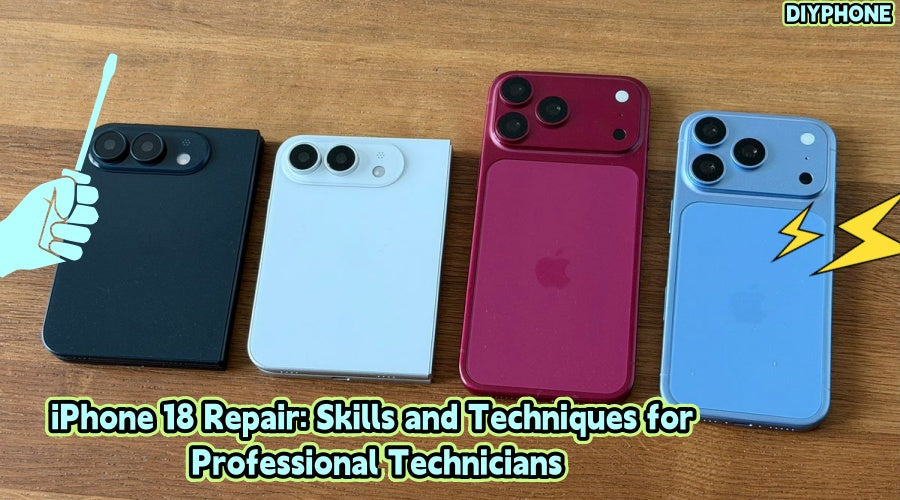
As the iPhone 18 series enters the market, the mobile phone repair industry faces new challenges. Evolving hardware, camera systems, communication technologies, and repair procedures demand greater expertise from technicians. Experience alone is no longer enough; technicians must also master fault diagnosis, software configuration, and data security to keep up with industry changes.

I. Diagnostic and Software Technologies
1. Fault Diagnosis Skills
In the past, when a mobile phone failed to power on, drained its battery quickly, restarted frequently, or could not charge, some repair technicians would rely on experience and directly replace the iPhone Battery, charging port, or related chips. Today, when dealing with new models in the iPhone 18 series, it is more important to first identify the cause of the fault:
· Improve current testing capabilities
Use information such as standby current, startup current, and power supply sequencing to determine whether the device has a short circuit or a power supply abnormality.
· Distinguish between software and hardware faults
Phone restarts, lag, or abnormal functions are not necessarily caused by hardware damage. System and configuration factors must also be considered.
· Follow a complete inspection process
Gradually narrow down the fault range, starting with appearance inspections, connector checks, and peripheral circuit measurements.
Advances in repair technology are not just about performing operations faster. More importantly, they involve accurately identifying faults and reducing unnecessary part replacements and repeat repairs.
2. Precision Camera Repair
When a phone experiences blurry photos, focusing failures, image shaking, or a black camera screen, repair technicians need to further determine whether the fault originates from the camera module, flex cable, peripheral circuit, or system configuration.
· Understand the structure
Understand the structure of the camera module and the layout of its flex cables to reduce the risk of damage during disassembly and reassembly.
· Understand inspection methods
Master basic inspection methods for focusing, exposure, and image quality to accurately identify imaging problems.
· Choose the appropriate repair method
Select a repair method based on the severity of the fault, taking into account module replacement, peripheral circuit repair, and repair costs.
Not every fault in a precision camera module is suitable for disassembly and repair. Knowing when to repair and when to replace a component is also an important demonstration of a repair technician's professional capabilities.
3. Component Calibration and Software Configuration
If only the physical replacement is completed while subsequent steps are overlooked, problems such as component notifications, abnormal functions, or incomplete repair procedures may occur. Therefore, software skills are becoming an essential aspect of mobile phone repair that technicians cannot afford to overlook.
· Understand the device
Familiarize yourself with the component and repair history information under “Settings — General — About” to understand how the device recognizes replaced components.
· Understand the problem
Learn to distinguish between hardware damage, incomplete calibration, and component compatibility issues to avoid misdiagnosis.

II. Hardware Repair Technologies
1. Precision Motherboard Repair
Motherboard repair remains an important technical field in the mobile phone repair industry. Repair technicians must pay greater attention to the basis for their diagnoses and the risks involved in repairs. Strengthen inspection capabilities for power management, charging circuits, and peripheral power supply circuits. Improve precision operation skills under a microscope and become familiar with the repair requirements of high-density connectors and fine-pitch components. Use measurement data to narrow down the fault range and avoid directly replacing important chips without sufficient evidence.
2. Disassembly, Reassembly, and Battery Safety
As iPhone 18 models feature increasingly precise internal structures, careful disassembly is essential. Use a suitable screen separator, control temperature and pressure, and avoid damaging the screen or flex cables. Follow repair guidelines when handling batteries and seals to prevent battery damage.
These basic operations directly affect repair costs and device safety. The more valuable the device, the more important it is to follow standardized procedures rather than simply pursuing faster disassembly.
3. Communication and RF Testing
No service, weak signals, dropped calls, and mobile data issues can involve antennas, connectors, RF circuits, baseband systems, SIM card settings, or carrier networks. Technicians need a systematic approach to identify the cause.
· Check whether antenna contacts, coaxial cables, and related connectors are loose, deformed, or damaged.
· Distinguish between antenna reception abnormalities, RF peripheral circuit faults, and baseband-related problems. Avoid directly attributing a lack of signal to motherboard damage.
· Combine SIM card checks, network settings, and test results from different environments to gradually narrow down the fault range.
· When dealing with complex RF problems, conduct inspections according to your equipment and technical capabilities, and use professional equipment for further troubleshooting when necessary.
For small and medium-sized repair shops, there is no need to invest heavily in expensive equipment from the beginning. However, they should gradually strengthen their understanding of communication principles and basic testing capabilities.

III. New Opportunities in the Repair Industry
1. Expand into Higher-Value Repair Services
As competition in screen and battery replacement grows, low-price strategies can reduce profits. iPhone 18 complex diagnostics, motherboard repairs, communication troubleshooting, and water damage assessments offer higher-value services and help technicians build a competitive advantage.
2. Establish Standardized Repair Procedures
Repair quality is reflected not only in technical operations but also throughout the entire service process. From device intake inspections and fault confirmation to repair quotations, repair records, functional retesting, and delivery explanations, every step should follow a standardized process as much as possible. Standardized procedures can reduce missed inspections and misdiagnoses while also helping to reduce after-sales disputes.
3. Continuously Learn New Technologies
As new models continue to be released, repair documentation, component structures, and software procedures may also change accordingly. Repair technicians cannot rely solely on past experience and should continue learning new technologies.
· Follow reliable repair documentation and applicable technical documents officially released by manufacturers.
· Record inspection procedures, measurement data, and final solutions based on actual fault cases.
· Review cases to summarize common faults and gradually develop your own diagnostic approach.
· Appropriately invest in professional mobile phone repair equipment, such as a laser separator or Thermal Imaging Camera, to improve repair efficiency.
Only by combining theoretical knowledge with practical repair experience can technicians truly improve their ability to handle complex faults.
4. Prioritize Data Security and Customer Service
Phones contain sensitive personal and work data. Explain potential data risks before repairs and obtain customer authorization for operations that may cause data loss, such as firmware flashing or system restoration. Professional, transparent service builds trust, strengthens customer relationships, and sets repair shops apart from low-price competitors.

IV. Future Development Directions
1. Strengthen Fundamental Hardware Repair Skills
Regardless of how mobile phone technology develops, circuit analysis, precision soldering, disassembly and reassembly, and fault measurement remain essential skills that repair technicians must master. Only with a solid foundation can technicians identify the right starting point when facing complex faults, rather than relying on repeated part replacements and luck.
2. Improve Comprehensive Diagnostic Capabilities
In the future, the differences between repair technicians will depend not only on who is better at soldering but also on who can comprehensively assess hardware faults, software abnormalities, and component configuration issues. Technicians who can independently complete diagnosis, repair, and functional retesting will find it easier to establish consistent repair quality and a strong customer reputation.
3. Strengthen Standardized Business Practices
As device values increase and repair procedures become more complex, repair risks and customer expectations will also increase. Clearly defining the scope of repairs, providing reasonable quotations, following standardized procedures, protecting customer data, and truthfully explaining the device's condition after repair are essential to reducing unnecessary disputes and turning technical capabilities into long-term competitiveness.
Conclusion
The changes brought by the iPhone 18 series mean that the capabilities repair technicians need to improve in the future will extend beyond disassembly and soldering techniques. They will also include comprehensive skills in system diagnostics, camera testing, software calibration, motherboard repair, communication analysis, and data security.
At the same time, new models also create new opportunities for repair professionals with specialized technical skills, standardized procedures, and a strong commitment to customer service. Comprehensive fault assessment, the use of Professional Phone Repair Tools, and the provision of reliable services are the core competitive advantages that will enable repair technicians to maintain a long-term position in the industry.


