
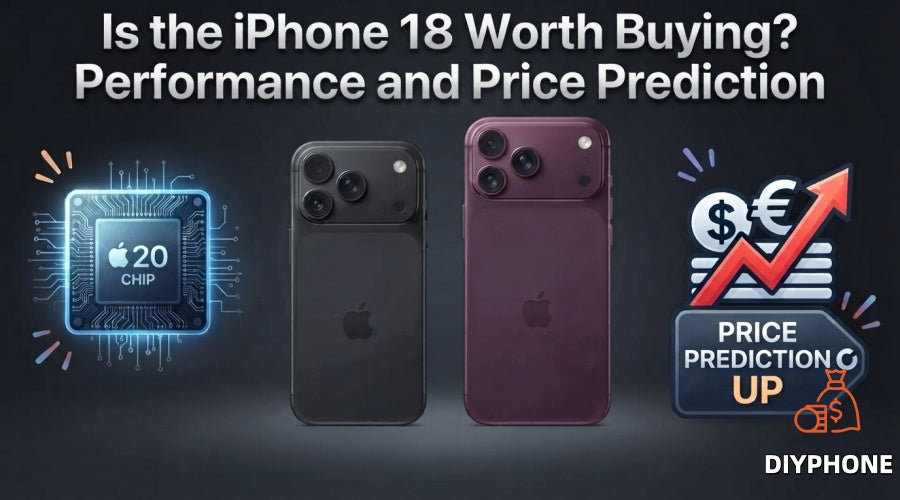
As the second half of 2026 arrives, details regarding the next-generation iPhone 18 are becoming clearer. It is highly worth watching, but it may not be a must-buy for everyone. It is ideal if you want top performance, a complete AI experience, and innovative design, but the Pro series may see its largest price increase yet. DIYPHONE analyzes this across core upgrades, historical pricing, hardware fixes, and buying advice to help you decide if you need this new model.

I. Upgrade Highlights and Predictions
The iPhone 18 is expected to bring leapfrog upgrades at the hardware level, with some highlights being touted as the best in recent years:
1. Performance Revolution
The Pro series is expected to debut the A20 chip built on TSMC's 2-nanometer process. Stepping from 3-nanometer to 2-nanometer not only means a massive reduction in power consumption, but also brings a giant leap in local AI computing capabilities. Coupled with the upgraded, ultra-large 12GB RAM, edge-side large models—which previously could not run smoothly due to memory constraints—will achieve true "second-level responsiveness" on the iPhone 18.
2. Camera Updates
Rumor has it that the Pro series will break away from fixed aperture limitations and introduce physical variable aperture technology. This means that in low-light environments, the phone can automatically enlarge the aperture to capture more light intake and reduce noise; whereas when light is sufficient or when shooting landscapes, it can shrink the aperture to obtain a clearer depth-of-field performance. The creative flexibility for image creators will reach an unprecedented height.
3. Battery Life and Design
To support the powerful AI computing power, the battery capacity of the Pro Max is rumored to approach 5,200mAh, making it the model with the strongest battery life across all generations. In addition, Apple may break the traditional rhythm of releasing the entire lineup at the same time. In order to allow the supply chain to be more focused, the standard version and the all-new Air series might be delayed until the spring of 2027 for publication.

II. Price Increase
Behind every model version upgrade lies high manufacturing costs. Combined with the continuous soaring of flash memory and RAM component prices, the iPhone 18 Pro series may face the most severe price-hike pressure in history. To give everyone a more intuitive feel, we might as well look back at the official debut pricing of several recent classic generations:
1. iPhone 13 and 14 Series
· The starting price of the iPhone 13 Pro was $999, and the Pro Max was $1099.
· When it came to the iPhone 14 Pro series, despite rumors of a price hike, Apple ultimately withstood the pressure in the North American market, maintaining the starting prices of $999 and $1099.
2. iPhone 15 and 16 Series
· On the iPhone 15 Pro Max, Apple eliminated the 128GB version, starting directly from 256GB, which disguisedly raised the actual entry barrier to $1199, while the Pro still maintained at $999.
· The iPhone 16 Pro series continued this pricing strategy (Pro $999, Pro Max $1199), but by this time, the cost pressure from the component supply chain had already begun to accumulate.
3. Predicting the iPhone 18 Series
· Industry experts predict that, affected by the extremely low yield rate of the 2-nanometer chip process and the skyrocketing cost of 12GB RAM, the starting price of the iPhone 18 Pro series may face a massive surge of up to $200.
· This means that the starting price of the iPhone 18 Pro may historically break through to $1199, while the starting price of the Pro Max may even soar directly to $1399. Such a high price will undoubtedly turn away a large portion of daily users with limited budgets.

III. Hardware Craftsmanship Optimization
In addition to performance improvements, Apple has also put great effort into the internal structural design of the iPhone 18. Looking back at the past few generations of products, many users and mobile phone repair teardown bloggers have pointed out some stubborn, common hardware faults. On the iPhone 18, these problems are expected to be fundamentally optimized:
1. Improvement of Motherboard Heat Dissipation
From the iPhone 13 to the iPhone 15 series, although the dual-layer motherboard design saved space, it very easily led to heat accumulation, often causing screen dimming and frame drops during gaming. The iPhone 18 is expected to comprehensively adopt graphene heat dissipation sheets paired with a metal-cased battery design to thoroughly improve heat dissipation. Previously, when technicians repaired pseudo-soldering issues caused by heating, they often needed to use a smart heating station to separate the dual-layer motherboard for jumper wires or re-balling. This time, the optimization of the hardware structure will reduce the probability of motherboard damage due to long-term high temperatures from the source.
2. Charging Port and Internal Reinforcement
Since the iPhone 15 series switched to the Type-C interface, although charging has become more convenient, due to deviations in daily plugging angles, some users have reported that the pins inside the interface are prone to wear or loosening, resulting in intermittent charging or inability to transfer data. The iPhone 18 adopts an all-new titanium alloy reinforcement bracket at the internal charging port ribbon cable, significantly improving resistance to twisting and pulling. Even if users have bad habits, they will no longer need to frequently visit repair shops to have technicians use micro electric screwdrivers and precision tweezers to disassemble the machine and replace the entire charging port ribbon cable.
3. Drop-resistance Reinforcement
In order to facilitate low-cost repairs, the iPhone 14 and 15 series adopted a detachable rear glass design, but this also led to a decline in the rigidity of the entire machine, making the back cover extremely easy to shatter when dropped at specific angles. The iPhone 18 will further optimize locking structures such as the metal middle frame to disperse stress during impacts, making the body more sturdy and durable.

IV. Purchasing Advice
Faced with the iPhone 18, which has skyrocketing performance alongside skyrocketing prices, blindly following the trend is clearly inadvisable. According to different usage needs, we provide the following clear classification suggestions:
1. Demographics to Buy Directly
· Heavy mobile gamers: The ultra-strong power efficiency ratio brought by the 2-nanometer A20 chip and the 12GB RAM will allow you to completely say goodbye to heating and stuttering when playing large open-world mobile games.
· Professional image creators: The physical-level depth of field and low-light image quality improvement brought by variable aperture technology are unmatched by any previous generation of iPhone, and can directly boost video productivity.
· Those with a sufficient budget: If you refuse to use anything but the latest technology and hope to fully experience the most cutting-edge edge-side artificial intelligence of the next few years, then the iPhone 18 Pro series is tailor-made for you.
2. Demographics Suggested to Wait and See
· Daily users pursuing high cost-effectiveness: The performance of current previous-generation models, such as the iPhone 15 Pro or iPhone 16, is already severely excessive for browsing short videos, daily photography, and chatting on WeChat.
· Users with no strong demand for AI: If you rarely use intelligent assistants or productivity tools on your phone in daily life, paying a premium of an extra $200 for an AI feature that is still in its developmental stage is clearly not worthwhile. For this segment of users, buying the discounted previous-generation Pro series in reverse when the iPhone 18 hits the market is a more rational spending plan.


