
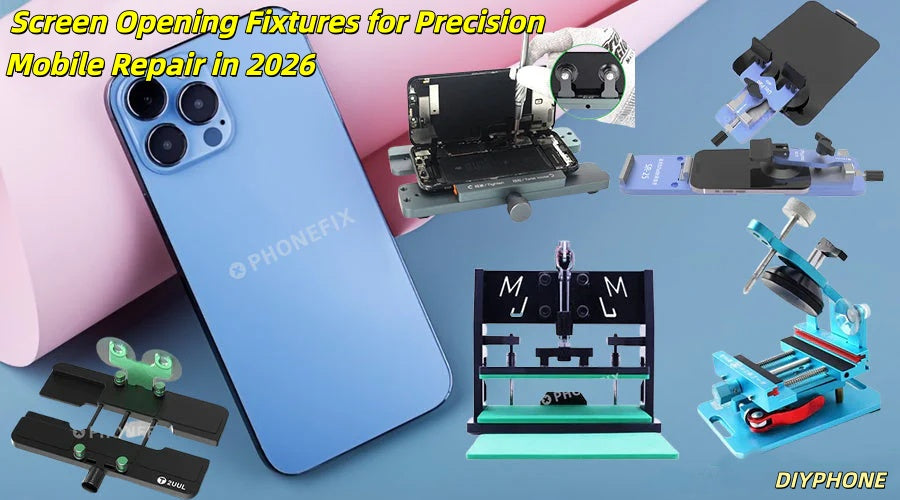
In 2026, the speed of technological iteration is always faster than the evolution of tools. As smartphones advance toward ultra-thin bodies, extremely narrow bezels, and high water resistance, the difficulty of screen disassembly is also increasing. In daily repair scenarios, using a Screen Opening Fixture is essential. As a professional repair technician, understanding and deeply mastering the application of such tools is the only way to improve the repair success rate.

I. Core Application Scenarios
In professional mobile phone repair scenarios, a screen opening fixture is not just a simple fixing base; it is the primary guarantee for ensuring repair success rates.
1. Non-destructive and Safe Screen Opening
The interior of modern smartphone bezels is filled with a large amount of high-viscosity waterproof adhesive. Traditional disassembly methods rely on manual pulling after heating, which easily leads to uneven pressure on the inner screen, causing LCD liquid leakage or OLED cracking.
2. Screen Bonding and Curing
The "pressing" step after replacing a screen is equally crucial. In the past, repair shops often used rubber bands to bundle phones, which not only resulted in uneven pressure but also easily caused the screen edges to warp or bubbles to form due to excessive force.
3. Back Glass and Special Model Disassembly
Facing back panels made of extremely fragile glass, this type of Screen Opening Fixture also performs excellently. It can not only firmly lock the body to prevent the phone from sliding when disassembling cracked back glass but also work with laser back glass removal machines to ensure stable output of the device under high-temperature laser operation, avoiding unnecessary hardware damage.

II. Core Industry Advantages
Between repair efficiency and yield, a professional Screen Opening Fixture provides the perfect balance.
1. Risk Control
When using old-fashioned suction cups or ordinary pry bars, repairers often need to judge the pulling force by "feel," which has extremely high uncertainty, especially when dealing with narrow-bezel models such as iPhone 12 to iPhone 16. Once the hand shakes, the screen assembly is ruined. Professional mechanical screen removal tools convert "manpower" into "standardized mechanical force," reducing the risk of screen breakage to the industry's lowest level.
2. Improving Efficiency
During busy repair seasons, time is money. The old manual screen opening method requires the repairer to keep pressure and hold the screen opening tool at all times, making it impossible to step away. Mechanical screen opening fixtures support pressure presets. After the technician completes the screen opening and positioning, they can handle other repair tasks, truly realizing the automation and standardization of the workbench.
3. Detailed Consideration for Protecting Device Appearance
The various fixtures we provide use high-density silicone or anti-static rubber protective pads on the parts in contact with the mobile phone. This means that when applying a gripping force of up to several kilograms, the metal frame, camera module, and button components of the mobile phone can receive comprehensive physical protection without leaving any scratches, meeting the customer's high expectations for repair quality.

III. Tutorials and Other Tool Cooperation
1. Usage Process
Step1. Preheating Treatment: Use a constant-temperature Screen Heating Station to heat the mobile phone to about 70-80°C for 3-5 minutes to completely soften the strong bezel adhesive.
Step2. Position Calibration: Place the mobile phone in the center of the fixture and adjust the bracket to ensure that the suction cup is located at the center above the screen and does not cover sensitive areas such as the front-facing camera. Slowly rotate the pressure adjustment handle and stop when the suction cup is completely attached and generates slight tension.
Step3. Bezel Auxiliary Cutting: While the fixture provides continuous tension, use an ultra-thin metal screen opening tool to gently slide along the bezel gap. Since the fixture has already pulled open a small gap, the difficulty of operating the screen opening tool is greatly reduced. As the gap increases, gradually rotate the fixture knob to maintain the tension until the screen is completely detached.
2. Tool Cooperation
· Screen Heating Station: The fixture is responsible for pulling, and the heating station is responsible for melting the glue. The heating station ensures that the glue is in the easiest state for disassembly, so that the operation of the fixture can truly be non-destructive.
· Screen Opening Tool: Insert a high-toughness, ultra-thin screen opening tool into the gap pre-stretched by the fixture. This combination is currently the optimal solution for repairing high-difficulty models.
· Intelligent Positioning Tool: After the screen is installed, replace the fixture with a professional pressure positioning tool for continuous constant-pressure curing to ensure the restoration of waterproof performance.
Conclusion
In the 2026 mobile phone repair market, customers are more concerned about whether the mobile phone repair is professional, whether there are traces left, and whether the sealing is as good as before. In this process, the screen opening fixture plays an irreplaceable role as a Mobile Repair Tool, serving as a barrier to successfully reduce the risk of screen breakage. For repairers who want to stand out in a highly competitive market, abandon those inefficient and high-risk old tools and invest in more modern solutions.


