
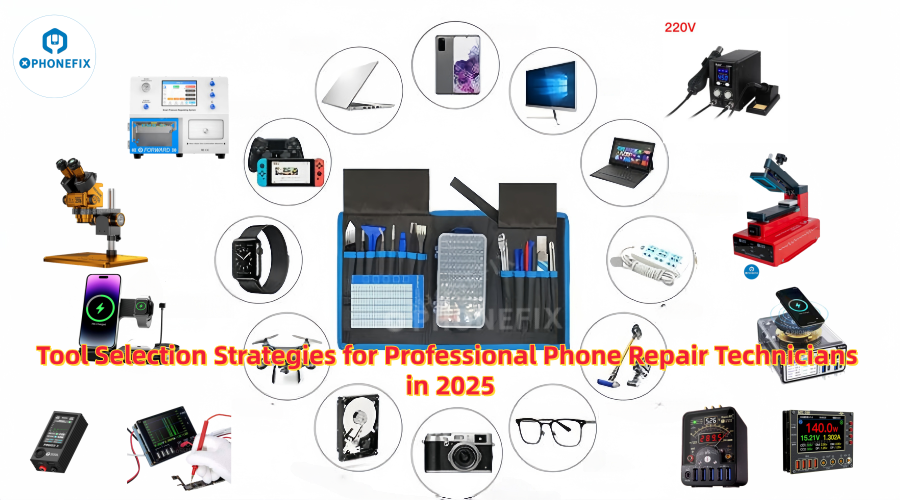
By 2025, the fast changing technological landscape will make tools more than just tools for jobs; they will be essential components for assuring device safety and repair efficiency. With a focus on several factors, such as task complexity, tool quality and compatibility, and electrostatic safety, this article, Phonefix will examine how expert repair technicians can choose the best tool combination for their requirements in 2025. Practitioners will be able to improve their technical performance and equipment strategy as a result.

I. Matching Tools to Repair Complexity
In practice, different repair tasks require different levels of tools. Technicians usually classify Phone repair tools into basic repairs and advanced repairs based on the complexity of the task, and match the corresponding tools accordingly.
1. Basic Repair: Prioritizing Precision, Safety, and Convenience
Recommended Tools:
· Precision Screwdriver Set: Used for disassembling the phone's exterior and internal components, covering a variety of screw types (such as Phillips, Torx, and Y-shaped).
· Plastic Pry Tool: Used for non-destructive opening and screen separation, effectively preventing scratches and cracks.
· Suction Cup Tool: Assists in screen separation, particularly for tightly attached OLED panels.
· Anti-static Tweezers: Used for extracting small components, avoiding contamination or static damage from hand contact.
This stage is characterized by "high frequency, low risk," emphasizing ease of operation and tool controllability. These tools are used for replacing surface components such as the screen, battery, iPhone camera parts, and earpiece.

2. Advanced Repairs: Professional-Grade Equipment Ensures Safety and Accuracy
Recommended Tools:
· Adjustable Temperature Soldering Iron and Solder Wipes: Used for desoldering and reconnecting motherboard solder joints. Precise temperature control is required to prevent overheating and damaging components.
· Hot Air Gun: Suitable for tasks like desoldering BGA chips and replacing flexible cables. Adjustable temperature and air flow are crucial.
· Digital Multimeter: Used to measure voltage, current, and resistance, and diagnose motherboard faults, battery anomalies, or short circuits.
Advanced repairs require extremely precise operation. Professional-grade tools can greatly increase success rates and significantly reduce return rates. These tools are suitable for applications such as iPhone motherboard repairs, solder joint repairs, connector replacements, and circuit testing.
II. Key Considerations for Tool Selection
Repair tool selection should be based not only on the type of task but also on a balance of factors such as quality, compatibility, and device protection requirements.
1. Tool Quality and Durability
High-quality tools have a longer lifespan, stable performance, and are less damaging to delicate electronic devices. For example, low-quality screwdrivers can easily strip, wear out screw holes, and, in severe cases, directly damage motherboard connections. Therefore, professional technicians generally prefer high-end tools from reputable brands or certified tools.

2. Multi-Model Compatibility
There are numerous mobile phone brands and models on the market, and different models vary in screw types, housing structures, and battery layouts. To address diverse repair needs, technicians typically carry a comprehensive set of screwdriver bits in various sizes and Phone disassembly tools to ensure flexibility in various scenarios.
3. Anti-static Protection Measures
Electrostatic discharge (ESD) can cause permanent damage to electronic components when handling motherboards, batteries, or other sensitive components. To address this, professional repair personnel typically carry the following anti-static equipment:
· Anti-static wrist strap: This wrist strap, which uses a grounding cord to dissipate static electricity from the body, is standard equipment for motherboard repairs.
· Anti-static tweezers and mat: Used for handling and placing components to prevent static buildup.

In 2025, with the further integration of chips from brands like Qualcomm and Apple, and their increased sensitivity to static electricity, anti-static measures have become essential for professional maintenance personnel.
III. Tool Selection Strategies for Different Career Stages
1. Beginner/Entry-Level Technicians
It is recommended to start with basic repair tools, prioritizing the quality and practicality of the following:
· Multi-tip screwdriver set
· Spudger and suction cup
· Anti-static tweezers
· Digital multimeter
Initially, you can gradually explore the compatibility of various tools through hands-on practice, and then gradually expand to more advanced tools as you gain experience.

2. Experienced Repair Engineers
Based on the type of work they perform and the depth of their repairs, they should expand their equipment to include specialized equipment, such as:
· Adjustable temperature soldering iron and soldering stand
· Hot air rework station
· Motherboard magnifying glass or HD trinocular microscope
· Dedicated test fixture and power supply tester
These technicians often have a relatively well-developed repair skill set and prioritize efficiency and professionalism when selecting tools.
Getting the proper tools is the first step to fixing your phone successfully. Purchase from the official China Phonefix website to confidently and expertly undertake any repair task, whether it's replacing a screen, fixing a motherboard, or cleaning a water-damaged gadget. Recall that purchasing high-quality tools will improve your reputation as a knowledgeable, reliable technician in addition to your ability to do repairs.


