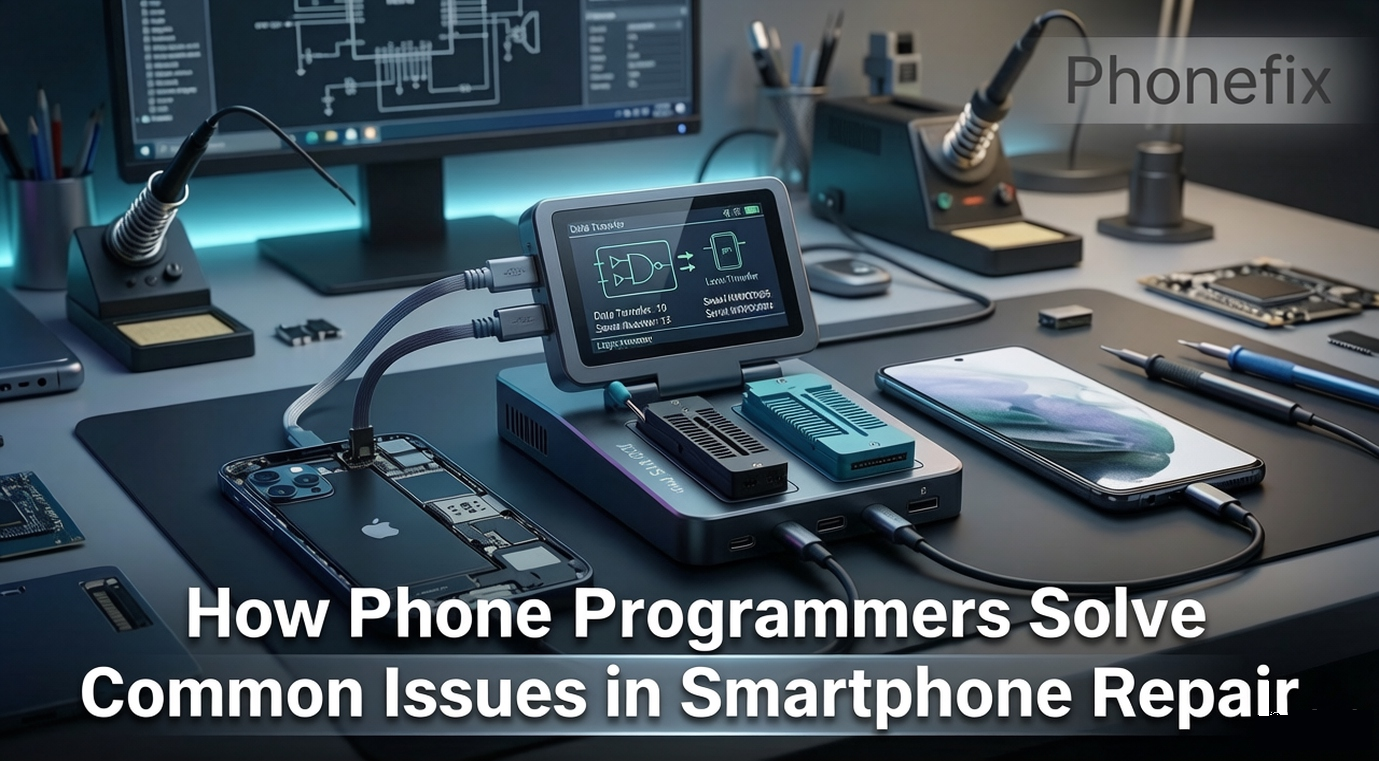
Modern smartphones are not the same as basic electronic devices. In the past, replacing a cracked screen or a degraded battery was a simple "plug-and-play" hardware process. Today, however, manufacturers like Apple and Samsung use strict component serialization. Even with a genuine OEM replacement part, a device may trigger software locks—displaying warnings like "Important Display Message" or completely disabling features like True Tone and Face ID. This article will explore how phone chip programmers solve these serialization issues, examining their key functions, their synergy with diagnostic tools, and the critical mistakes technicians must avoid in modern smartphone repair.

I. What Is a Phone Chip Programmer?
· A Phone Chip Programmer is a specialized diagnostic and data-transfer device used to read, write, edit, and backup data stored on a smartphone’s internal microchips. These microchips include the EEPROM (Electrically Erasable Programmable Read-Only Memory), NAND flash, baseband, and logic EEPROMs found on individual components.
· The device works through data cloning. Every major component in a modern smartphone carries a unique cryptographic serial number bound to the motherboard. When a part breaks, a programmer extracts this vital identifier from the original, damaged component and flashes it onto the new replacement piece. This data manipulation has shifted the paradigm of smartphone repair from pure hardware soldering to sophisticated software alignment.
II. 5 Key Functions of Phone Programmers in Smartphone Repair
To understand why these devices are indispensable, we must look at how they solve five of the most critical issues encountered during daily repairs.
1. Screen Data Restoration
· The Issue: Replacing a screen often causes the immediate loss of ambient light features, such as Apple’s True Tone. In some cases, it can also cause erratic touch sensitivity or calibration anomalies because the phone realizes the screen's hardware ID does not match.
· The Solution: The technician plugs the original screen into the programmer to read its MtSN (matrix serial number). The programmer stores this data, the technician swaps the boards, and the data is written directly onto the new screen. This tricks the phone into recognizing the new panel as the original, instantly restoring True Tone.
2. Battery Health & Cycle Count Resetting
· The Issue: When a smartphone battery is replaced, the device often throws an "Unknown Part" warning. Worse yet, the operating system will refuse to read the new battery's metrics, continuing to display the old battery’s degraded health percentage instead of resetting to 100%.
· The Solution: Technicians use a programmer alongside a specialized "tag-on" flex cable. The programmer modifies the data stored on the battery's Texas Instruments (TI) gas gauge chip, resetting the cycle count to zero and forcing the phone's OS to update the maximum capacity to 100%.
3. Face ID and TrueDepth Camera Repair
· The Issue: Face ID components, particularly the dot projector and flood illuminator, are uniquely paired to the CPU. If the dot projector is damaged by water or dropped, replacing it outright disables biometric security permanently.
· The Solution: Advanced programmers allow technicians to read the original cryptographic data from the damaged dot projector chip. This data is then burned onto a brand-new, compatible replacement flex cable. By preserving the original data profile, Face ID functionality is completely revived without requiring a costly logic board replacement.

4. NAND Flash Memory Upgrades & Data Recovery
· The Issue: Devices suffering from inadequate storage or a corrupted memory chip often get stuck in a continuous boot-loop.
· The Solution: Programmers equipped with PCIE/NAND sockets act as an external drive reader. Technicians can desolder the NAND chip, place it in the programmer, and extract the vital syscfg (system configuration) data. This data is then flashed onto a brand-new, higher-capacity NAND chip, effectively repairing the boot-loop or upgrading the phone's storage.
5. Vibrator Serial Matching
· The Issue: Swapping a haptic motor or Taptic Engine without data synchronization often results in a phone that completely refuses to vibrate, or yields incredibly weak, uncoordinated haptic feedback.
· The Solution: Much like screen repair, the programmer copies the unique identification code from the old vibration motor and writes it to the new one, ensuring the operating system drives the linear motor with the correct frequencies.
III. The Role of DC Power Cables in Programmer-Based Repairs
· A phone programmer rarely works in isolation; it relies heavily on a symbiotic relationship with a DC Power Supply and specialized diagnostic boot cables.
· When modifying or testing sensitive chip data, technicians cannot rely on a standard battery, which might be unstable or uncharged. DC power cables allow the technician to safely boot the phone's motherboard directly on the workbench.
· By observing the amperage draw (current consumption) on the DC power supply while interacting with the programmer, a technician can immediately tell if a data flash was successful or if a chip has short-circuited. For example, a sudden spike in current indicates a hardware short, while a stagnant, low current suggests a data corruption issue that requires further programming.
IV. Common Mistakes Technicians Make Without a Programmer
Operating a repair shop without a programmer leads to three critical, costly mistakes:
· Generating "Software E-Waste": Blindly swapping parts creates a device crippled by error pop-ups and missing features. This drastically lowers the resale value of the smartphone and damages customer trust.
· Discarding Original "Dead" Parts Too Quickly: A common amateur mistake is throwing away a shattered screen or dead battery before reading its data. Once that original chip data is lost, restoring features like True Tone becomes an incredibly complex, time-consuming nightmare that often requires cloud-data retrieval or jailbreaking.
· Misdiagnosing Software Pairing as Defective Hardware: Technicians without these tools often waste hours returning perfectly functional replacement parts to vendors, assuming they are "defective" when they simply lack the necessary serial number registration.

Phone programmers are no longer optional tools that are only used in advanced micro-soldering laboratories; they have become essential everyday Phone Repair Tools for survival in the modern repair landscape. As smartphone manufacturers continue to tighten security protocols and expand component serialization, the reliance on data-level manipulation will only intensify. Independent repair technicians can use phone programmers to bypass artificial software restrictions and perform successful repairs.