
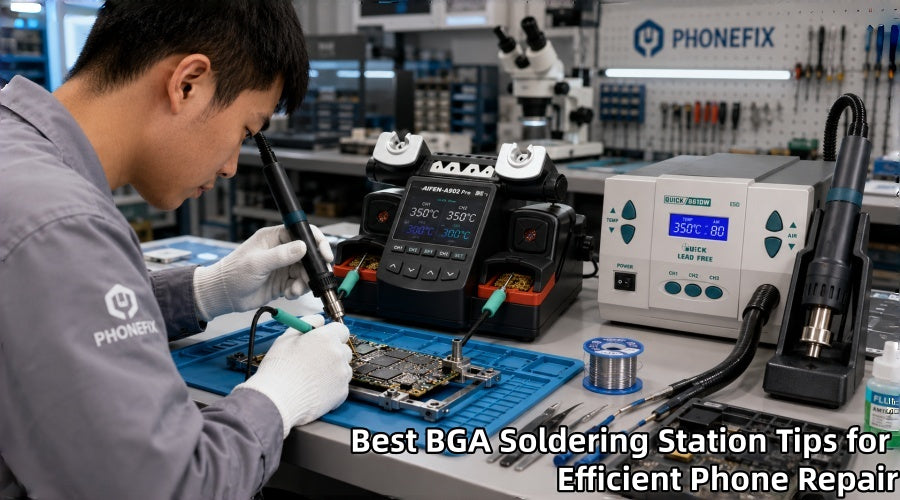
Modern smartphone repair has evolved beyond simple screens and batteries to complex BGA motherboard-level fixes for CPUs and ICs. For technicians, mastering professional BGA rework stations and standardized soldering techniques is essential to boost repair efficiency, maximize success rates, and drive business growth in an increasingly integrated market.

I. Why is a professional BGA rework station crucial for phone repair?
BGA (Ball Grid Array) package components have pins densely packed on the bottom of the chip. Ordinary heating tools can easily lead to uneven heating, causing motherboard deformation, solder pad detachment, or flying components from surrounding parts.
A high-quality BGA rework station provides:
· Precise temperature control and stable heat distribution.
· Safe chip removal and installation, minimizing the risk of damage to multi-layered micro-motherboards.
· Enhanced efficiency in handling complex repair tasks, making complex flying wires and micro-soldering more predictable.
When selecting a BGA rework station, focus on features such as adjustable top and bottom heating, precise infrared or hot air systems, temperature profile configuration, and robust PCB support fixtures.
II. Four Golden Rules for Efficient BGA Rework
To achieve perfect BGA soldering, technicians must strictly adhere to the following three core practices and meticulous operations:
1. Thoroughly Preheat the Motherboard, Avoid Thermal Shock
Never directly heat a cold PCB board with high-temperature hot air. The correct approach is to utilize the large bottom preheating plate of the BGA rework station, setting the temperature between 100°C and 150°C. Uniform heating effectively eliminates thermal stress, preventing copper wire breakage and motherboard warping.
2. Precisely Match Nozzle to Chip Size
The hot air nozzle must be in close contact with the target BGA chip:
· Avoid nozzles that are too large: Otherwise, they may melt or blow away surrounding sensitive micro-components.
· Avoid using nozzles that are too small: This can cause localized overheating, directly burning the silicon wafer inside the chip.
3. Strictly control the reflow soldering temperature profile
During the soldering stage, a scientific and controllable heating rate must be maintained:
· Heating rate: Maintain between ~2°C and 3°C per second.
· Maximum soldering temperature: Should be strictly controlled between 200°C and 210°C to protect the surrounding silicon structure.
· Peak temperature limit: Absolutely must not exceed 220°C, otherwise it will easily damage the fragile and sensitive integrated circuits.
4. Scientifically control the cooling stage
Before conducting on-machine testing, the motherboard must be allowed to cool gradually and naturally. Sudden rapid cooling (such as using a cooling fan) will put enormous stress on the newly formed solder joints, creating micro-cracks that are not easily visible to the naked eye, leading to recurring cold solder joints.

III. Five Basic Stages of Standard BGA Soldering
Following a structured operating procedure is a good way to avoid risks. A standard procedure typically includes:
[1. Diagnosis and Preparation] ➔ [2. Controlled Chip Removal] ➔ [3. Pad Cleaning and Inspection] ➔ [4. Chip Re-implantation/Replacement] ➔ [5. Reflow Soldering and Testing]
Skilled micro-soldering techniques are indispensable in these stages. Technicians need to be able to operate a fine-tipped soldering iron station precisely, repair flying leads, rebuild broken wires, and safely use flux and heat under a microscope. This perfectly solves various tricky problems in component-level replacement.
IV. How Can BGA Repair Help Repair Shops Increase Profitability?
For technical service shops such as mobile phone repair, adding BGA and advanced micro-soldering capabilities can open up a high-profit blue ocean for the business:
· Providing higher-value repair services: Upgrading from highly transparent, low-profit component replacement services to high-value motherboard-level repair.
· Expand customer base and technical credibility: Undertake repairs of devices that other ordinary shops cannot fix, including "crash" devices, "capacity upgrades," and "second-hand repairs," and even attract orders from competitors.
· Reduce reliance on simple component replacement: Through chip-level repair, significantly reduce the cost of purchasing expensive motherboards, establishing a core competitive advantage.
With the continuous evolution of smartphone hardware, precision repair technology has become an inevitable trend in the industry. By investing in professional Micro Soldering Tool such as BGA rework stations and precision micro soldering irons, and continuously standardizing temperature control curves and operating habits in daily practice, technicians can not only significantly improve repair efficiency and service quality, but also build a solid technical moat for repair shops in the fierce market competition.


