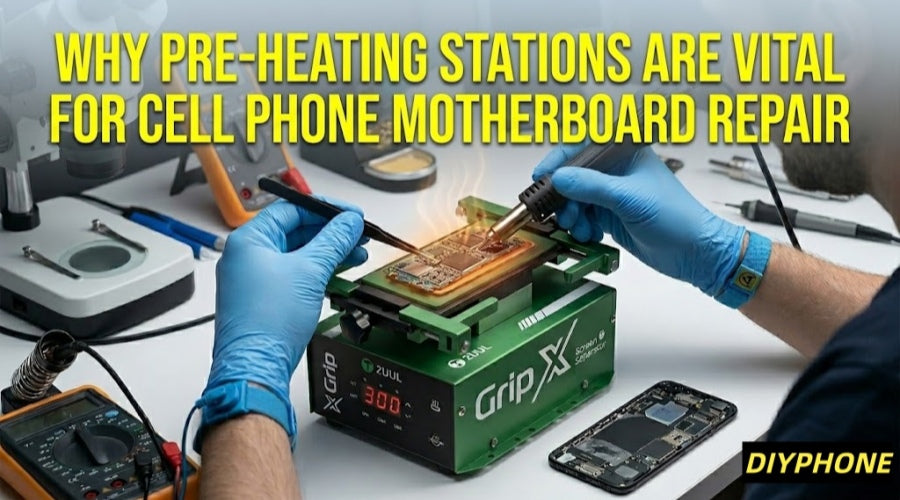
In the current mobile phone repair industry, relying solely on screwdrivers and prying picks is no longer sufficient; safer and faster screen removal tools are required. As a foundational constant-temperature heating tool, a pre-heating station provides uniform bottom-base heat to significantly improve desoldering efficiency. DIYPHONE analyzes the core applications, technical importance, and specific troubleshooting processes of pre-heating stations in cell phone repair.

I. Common Application Scenarios
During chip-level repair and peripheral disassembly, the large-area uniform heating provided by the pre-heating station establishes a stable temperature baseline for the motherboard.
1. Motherboard Layer Separation and Bonding
· Application Analysis: Since the widespread adoption of dual-layer motherboard designs in smartphones, the Screen Heating Separator has become an essential tool for standardized repair. Dual-layer motherboards are electrically connected through middle-frame solder pads, which are densely packed and precisely arranged. Specialized modular pre-heating stations can precisely control the melting point of the middle-frame solder via positioning fixtures for specific phone models, achieving non-destructive layer separation and resetting.
· Specific Malfunction: Taking the failure of the phone's Wi-Fi function or the inability to turn on Bluetooth as an example.
a. Fault Diagnosis: This malfunction is mostly caused by pseudo-soldering or broken lines on the dual-layer motherboard middle-frame solder joints due to external physical vibration, or by desoldering of the Wi-Fi chip pins.
b. Motherboard Separation: Remove the motherboard from the chassis and clean the residual fixing glue around the edges. Place the motherboard into the positioning mold of the dedicated pre-heating station, and set the temperature of the pre-heating station to 180°C. Once heated to the set temperature and the middle-frame solder reaches a molten critical state, use high-precision tweezers to lift the upper motherboard vertically, ensuring that hundreds of middle-frame array solder pads are not pulled or peeled.
c. Chip Rework and Bonding: Inspect or replace the Wi-Fi chip on the lower motherboard, and re-ball the chip and the middle-frame array using a BGA reballing stencil. Align the upper and lower motherboards, place them back onto the pre-heating station, and continue heating until the middle-frame solder balls are completely molten and automatically aligned and bonded, then turn off the power for natural cooling.

2. Motherboard Chip-Level Repair
· Application Analysis: When replacing large-volume BGA encapsulated chips such as the CPU, NAND flash memory, or power IC, if the bottom of the motherboard lacks heat support, blowing high-temperature air directly from above with a hot air gun (usually requiring 350°C-400°C) will cause a severe surface temperature difference on the motherboard, which easily triggers PCB delamination, copper foil blistering, or wafer damage inside the chip.
· Specific Malfunction: Taking device system boot failure, frequent restarting, or inability to power on as an example.
a. Cause of Fault: This phenomenon is mostly due to the core CPU being in a high-heat state for a long time, or solder ball cracking caused by physical impact.
b. Base Pre-heating and Removal: Fix the motherboard on a flatbed pre-heating station, set the base pre-heating temperature to 100°C-120°C, and heat continuously for 2-3 minutes. This step aims to expel moisture inside the PCB board and raise the base temperature of the entire substrate. Subsequently, use a hot air gun to apply uniform circular heating to the CPU surface. With the temperature compensation from the bottom pre-heating station, the upper hot air gun only needs to supplement a smaller amount of heat to make the overall chip reach the solder melting point, at which time a specialized prying knife can be used to remove the chip smoothly.
c. Glue Removal and Solder Scraping: Maintain the pre-heating station at a working state of 100°C. In this constant-temperature environment, the cured resin black glue on the surface of the motherboard and chip will soften significantly. When cooperating with a high-precision soldering iron and desoldering wick to clean residual solder, since the bottom heat maintains the solder in a semi-molten state, there is no need to apply excessive physical mechanical force to the motherboard, completely avoiding the risk of scraping and breaking the multi-layer traces inside the motherboard.
3. Display Assembly and Back Cover Separation
· Application Analysis: To meet IP68-grade water and dust resistance and fuselage rigidity requirements, modern smartphones mostly utilize high-strength, large-area industrial glue to bond screens and back covers.
· Specific Malfunction: Taking the replacement of the outer glass cover plate of a curved display screen as an example.
a. Softening the Medium: Place the phone assembly on a flatbed pre-heating station with a vacuum adsorption function, set the temperature to 80°C-90°C, and heat for 3-5 minutes to fully soften the frame glue around the screen and the internal OCA.
b. Physical Separation: Turn on the vacuum pump of the pre-heating station to securely adsorb the display assembly onto the surface. Use a molybdenum wire with a diameter of 0.03mm to pull and cut at a uniform speed through the gap between the outer glass and the inner display panel. The pre-heating station provides constant heat throughout the entire cutting process, ensuring that the OCA glue maintains a low viscosity state, preventing OLED panel liquid leakage, bright lines, or ribbon cable breakage caused by glue hardening and stiffening.

II. Technical Importance in the Repair Industry
In professional electronic repair processes, the introduction of the pre-heating station is a key indicator of the transition of repair craftsmanship from relying on personal experience to "standardized temperature control."
1. Balancing Thermal Stress
Modern smartphone motherboards generally adopt a highly integrated 10-layer to 12-layer PCB ultra-thin board design.
· Protection Technology: By providing overall substrate pre-heating, the pre-heating station significantly narrows the temperature gradient between the high-temperature zone of the Hot Air Gun and the room-temperature zone of the motherboard, causing the entire motherboard to expand uniformly with heat, fundamentally eliminating irreversible scrapping caused by motherboard bending and deformation.
· Physical Mechanism: According to the principle of thermal expansion and contraction, localized intense high temperatures cause the heated area to expand rapidly, while the surrounding room-temperature areas remain physically locked. This huge internal thermal stress difference leads to the breakage of micro-conductors or interlayer delamination inside the PCB board.
2. Reducing Heat Dissipation
· Thermal Conduction Inhibition: The large-area ground (GND) pins and copper foils on the motherboard possess extremely strong heat dissipation characteristics. Without bottom heating, the heat conducted by the hot air gun is rapidly absorbed and dissipated by the motherboard, preventing the solder from reaching the eutectic temperature; extending the heating time easily burns the surrounding plastic connectors.
· Optimizing Soldering Wettability: Raising the initial temperature of the substrate through the pre-heating station effectively slows down the dissipation rate of surface heat. During soldering reconstruction, the liquid solder exhibits better wettability and moderate surface tension, allowing the BGA chip to automatically and precisely reset by relying on the tension of the solder balls during the reflow soldering process, effectively avoiding soldering defects such as pseudo-soldering, false soldering, or bridging of adjacent solder joints.
3. Standardizing Repair Processes
· Improving Process Time Efficiency: With the constant-temperature assistance of the pre-heating station, the waiting time for chip disassembly, assembly, and residual glue cleaning is significantly shortened, transforming complex micro-soldering craftsmanship into a quantifiable standard operating procedure.
· Controlling Rework Loss: In the field of microelectronics repair, secondary rework is the main cause of hardware loss and time costs. Conducting standardized operations using a pre-heating station can reduce the rate of secondary failures caused by uneven motherboard heating to an extremely low level, guaranteeing the long-term operational stability of the device after repair.
IV. Conclusion
In summary, through a scientific temperature compensation mechanism, the pre-heating station resolves the difficult problem of thermal stress concentration during the thermal rework process of modern highly integrated PCB boards. In actual mobile phone repair operations, systematically cooperating the pre-heating station with professional Phone Repair Tools such as hot air guns and electric microscopes is an inevitable requirement for improving the success rate of motherboard repair and achieving standardized repair processes in mobile phone repair.