
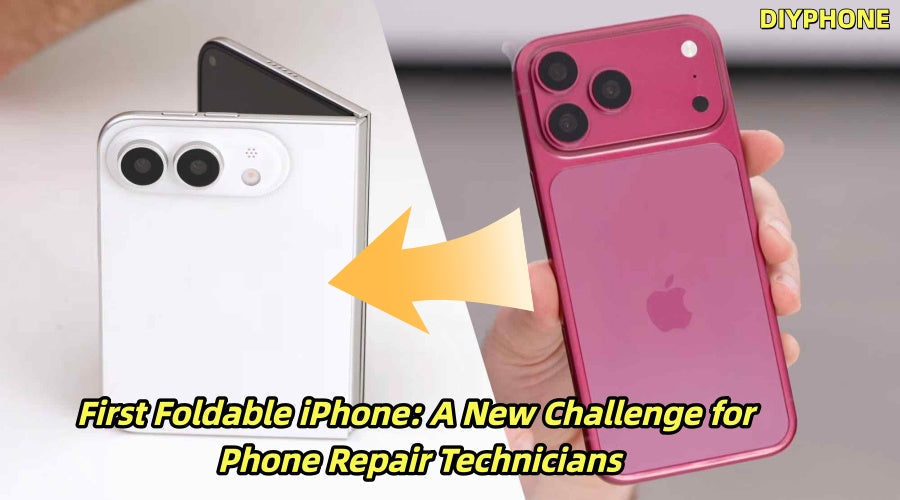
If the changes in the iPhone over the past few years have mainly focused on the chip, camera, and body design, then 2026 may bring a true change in form, with Apple's first foldable iPhone potentially making its official debut. For ordinary users, this means a larger screen and a more flexible user experience. But for the mobile phone repair industry, the significance of a foldable iPhone is more direct: the repair experience built around traditional iPhones in the past may need to be readjusted.

I. The Screen Has Changed
The most obvious change in a foldable iPhone is naturally the screen. Traditional iPhones use a fixed flat display assembly, while the core screen of a foldable iPhone needs to withstand a large number of repeated folds. Therefore, it is not simply an OLED panel, but involves multiple components such as the flexible display layer, ultra-thin glass, touch structure, protective layer, and special adhesives.
1. Screen Repair Becomes More Difficult
If Apple really adopts a flexible OLED with an almost invisible crease, repair technicians will be dealing with a display assembly that is more fragile and complex than that of a traditional iPhone. In the past, when a screen was cracked, in many cases the entire assembly could simply be replaced. However, when a foldable screen develops black lines, screen flickering, touch problems, or display issues in the folding area, repair technicians first need to determine whether the problem comes from the panel, flex cable, or folding structure.
2. The Folding Area Becomes a Key Focus
The folding area in the middle of the screen will become an important area for future repair inspections. Even if there is no obvious external damage, material fatigue, microcracks, or display abnormalities may occur after long-term use. Therefore, repair technicians will need to pay more attention to the internal condition of the screen rather than only observing the glass surface.
3. Higher Requirements for Repair Tools
In the future, when repairing the screen of a foldable iPhone, the requirements for disassembly, adhesive removal, and bonding processes will all increase significantly. Repair technicians may need to use a Trinocular Stereo Microscope to observe tiny damage and use different tools to assist with different components, but what truly determines repair quality will still be operational experience and an understanding of the folding structure. The emergence of the iPhone is very likely to gradually turn screen replacement from a standardized operation into a more precise repair job.

II. A More Complex Structure
Compared with the screen itself, what may truly give the repair industry a headache is the folding structure. Foldable phones need to incorporate a precision hinge between the two body sections, while also keeping the screen, flex cables, battery, and motherboard securely connected. Before carrying out repairs, it is necessary to first consider:
· Has the hinge become deformed?
· Is the opening and closing of the screen smooth?
· Have the flexible cables been pulled or strained?
· Have the internal components on either side of the body shifted?
If Apple adopts a more sophisticated hinge design, the hinge itself may even become an important repair item for the foldable iPhone. Especially after the phone is dropped or squeezed, even if the device can still function normally, the hinge and screen may already have been potentially affected.
In addition, in order to achieve a thinner body, Apple may adopt a more compact internal stacking structure and distribute components such as the battery across both sides of the foldable device. This may make the disassembly sequence more complicated:
· The protection requirements for flex cables and connectors will be higher.
· Battery replacement may require consideration of the structure on both sides at the same time.
· Repair technicians will need to pay more attention to the opening and closing condition of the body.
I think that in the future, when repairing a foldable iPhone, it will not be enough to simply think about which component is broken. It will first be necessary to determine whether the entire folding mechanism is functioning properly.

III. Higher Repair Barriers
If the foldable iPhone is officially launched, the most direct change for the repair industry will be the higher technical threshold. For example, if a phone develops an inner-screen touch problem, the issue may come from the display assembly itself, or it may come from the connection area. If the screen flickers after the phone is opened or closed, it cannot simply be determined that the screen is damaged; the hinge and flexible cables also need to be checked.
1. Motherboard Repair
The internal space of a foldable device is more compact, and the layout of the motherboard and connectors may also be more complex. Inspection under a microscope and micro-soldering skills will become more important.
2. Screen Repair
In addition to identifying display failures, technicians will also need to master the disassembly, separation, bonding, and protection processes of the iPhone OLED Screen.
3. Structural Inspection
Repair technicians will need to determine whether the hinge, frame, and folding area have been impacted, rather than only checking whether the phone can power on normally.
4. Post-Repair Testing
After replacing components, it will also be necessary to conduct complete tests on the display, touch function, battery, cameras, and various sensors.
In other words, the foldable iPhone may push the repair industry to move further from replacement-based repairs toward precision repair and fault analysis.

IV. Higher Costs
If the foldable iPhone uses a high-specification flexible screen, precision hinge, and ultra-thin body, its repair costs will most likely also be higher than those of a regular iPhone. In particular, the inner screen is very likely to become one of the most expensive components in the repair of the entire device. This will bring about an interesting change:
· The higher the price of the device, the more worthwhile it is for consumers to repair it, but the cost of the repair itself will also be higher.
· Repair costs after screen damage may increase significantly.
· A hinge failure may require the replacement of more complex structural components.
· Some faults may not be resolved through the simple replacement of a single component.
· Repair shops will need to invest more in professional equipment and training costs.
Therefore, the future repair market for foldable iPhones may become more clearly specialized. Ordinary repair shops can still handle basic issues such as batteries and outer screens, while complex repairs involving the inner screen, hinge, flex cables, and motherboard may gradually become concentrated in repair centers with professional equipment and skilled technicians.
V. The Industry Faces an Upgrade
In the past, repair technicians mainly dealt with flat screens, a single battery, and relatively fixed internal structures. After the emergence of foldable devices, the screen will bend, the body will move, and internal components will affect one another as the structure changes. For repair shops, preparing professional Phone Repair Tools in advance is only the foundation. More importantly, they need to establish disassembly, inspection, and repair processes specifically for foldable devices.
Of course, the specific name, configuration, and release date of Apple's first foldable iPhone still need to await official confirmation. For consumers, the foldable iPhone represents a new product form; for Apple, it is a new product attempt; and for the repair industry, it may be a new technical challenge.


