
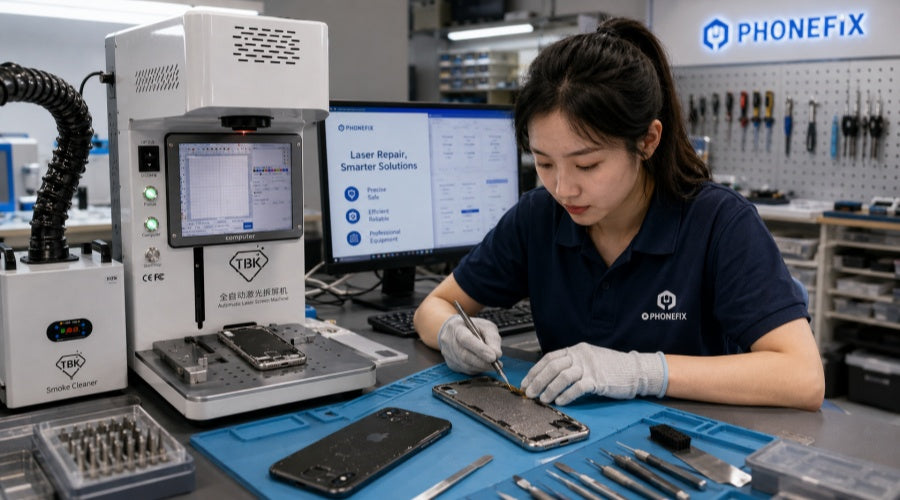
As iPhone designs become more advanced, back glass repair has become a valuable service in the repair industry. Laser marking machines use precise laser technology to remove adhesive layers quickly and safely, making repairs more efficient and consistent. For professional technicians, laser equipment improves productivity while creating new business opportunities.
I. Why is laser technology suitable for iPhone back glass repair?
Starting with the iPhone 8 series, Apple adopted a glass back design, securing the glass panel to the metal mid-frame using high-strength industrial adhesive. Because the glass is tightly bonded to the device structure, traditional repair methods often required replacing the entire housing, resulting in repair costs that could reach hundreds of dollars.
Laser repair technology has transformed this process. Using a high-precision laser beam, the equipment targets the adhesive layer beneath the glass, allowing technicians to replace only the damaged iPhone back glass rather than the entire body. Laser equipment achieves precise removal in the following ways:

1. Precise vaporization of the back glass adhesive layer
Laser machines typically utilize fiber lasers or UV lasers, directing a focused, high-energy beam at the paint layer and adhesive on the underside of the glass.
The laser penetrates the glass surface and is absorbed by the underlying black ink and adhesive. Once the energy reaches the set threshold, the adhesive layer rapidly heats up and vaporizes—turning into powder or ash—thereby reducing the bond strength between the glass and the device body.
Unlike traditional heating methods, the laser acts only on specific areas without generating excessive heat across the entire device, effectively minimizing the impact on surrounding components.
2. Reducing the risk of damage to internal components
iPhones contain numerous precision components, such as iPhone wireless charging coils, MagSafe magnetic arrays, camera modules, and motherboard assemblies. Prolonged heating with a hot air gun could cause these parts to overheat and fail.
Laser equipment uses specialized software to preset scanning paths for various iPhone models—ranging from the iPhone 8 to the latest iPhone 15/16 series—matching the process to the specific design specifications of each model. The equipment can bypass sensitive areas and target only the adhesive layers requiring removal, eliminating the need for technicians to forcefully disassemble the entire device chassis.
II. iPhone Rear Glass Laser Repair Process
Professional repair shops typically follow these steps to replace the rear glass:
Step 1: Equipment Preparation and Phone Disassembly
This stage typically involves removing:
· Logic Board
· Battery
· Camera Module
· Face ID-related components
Removing these parts prevents damage caused by heat, smoke, or glass fragments generated during the laser processing.
Step 2: Securing the Phone Housing and Calibration
After removing internal components, the empty housing is secured onto the laser equipment's work platform.
The equipment is usually equipped with an autofocus system that detects the phone's height and adjusts the laser focal length. Technicians also select the appropriate software template for the specific model to ensure the laser path aligns accurately.

Step 3: Laser Scanning to Remove Adhesive
Once the equipment is activated, the laser head scans along a preset path.
The laser rapidly ablates the adhesive beneath the rear glass, carbonizing it into a black powder. Some areas may require repeated scanning to ensure the adhesive is fully neutralized.
Professional equipment used in this process typically includes a smoke filtration system to capture smoke and particles generated during processing, thereby enhancing workplace safety.
Step 4: Removing Broken Glass and Cleaning the Surface
After laser processing, technicians can easily remove the shattered glass using Laser Engraving Machine.
For fragile areas like the camera module, an automatic center punch or precision tools are often used to carefully handle residual glass.
Subsequently, a thorough cleaning is required to remove:
· Residual adhesive
· Black carbonized residue
· Glass fragments
This ensures a flat, clean surface for the installation of the new rear glass.
Step 5: Installing the New Rear Glass
Once cleaning is complete, technicians install the new glass back panel using high-quality cold-press adhesive or specialized bonding materials.
Clamps are used to ensure the glass adheres perfectly to the chassis, followed by the final reassembly and testing of the phone.
III. Advantages of Laser Repair Over Traditional Methods
For mobile phone repair businesses, the greatest value of laser equipment lies in increased efficiency and reduced risk.
| Comparison Item | Laser Repair Method | Traditional Heat Gun Repair |
| Repair Time | Removal completed in approx. 15–30 minutes | Typically requires 1–3 hours |
| Operational Stability | Controlled by software program; results are more consistent | Heavily relies on the technician's personal experience |
| Chassis Damage Risk | Low risk; no physical brute-force prying required | High risk; easily leads to frame scratching or deformation |
| Internal Component Risk | Precisely controls heat and zones; high safety level | Highly likely to cause localized overheating and damage electronic components |
| Business Efficiency | Supports assembly-line batch processing, significantly increasing profit | Long per-unit duration, making it difficult to achieve scalable revenue |
While traditional methods rely heavily on the technician's experience, laser equipment utilizes digital control to standardize the repair process, ensuring consistent efficiency even when handling high volumes of orders.
IV. Key Features of Professional Laser Repair Equipment
When selecting laser equipment for iPhone back glass repair, focus on the following features:
1. Precise Laser Power Control
Most devices currently on the market use approximately 20W fiber lasers, striking a balance between speed and precision.
Adequate power allows for the rapid breakdown of adhesive layers while preventing excessive heat that could compromise the device's structural integrity.
2. Built-in Phone Model Database
Professional equipment typically comes with built-in processing templates for various iPhone models.
Technicians simply select the appropriate model, and the machine automatically executes the scanning path, significantly simplifying the operation.
3. Autofocus Functionality
Autofocus allows for rapid adjustment of the laser focal length, ensuring consistent results across every operation and boosting repair efficiency.
4. Integrated Fume Extraction System
Laser ablation of adhesive generates smoke and particles, making a fume extraction system a crucial component of professional equipment.
An effective filtration system improves the working environment and protects the health of repair technicians.
5. Compact, All-in-One Design
For repair shops with limited space, integrating the laser unit, computer control system, and fume extraction module into a single unit saves workspace and maximizes equipment utilization.

V. What Other Repair Services Can Laser Equipment Perform?
Beyond iPhone back glass removal, some laser devices also offer engraving and marking capabilities.
Repair shops can leverage these features to provide additional value-added services, such as:
· Personalized engraving on phone casings
· Marking of metal components
· Tool inventory management (ID marking)
· Custom logo engraving
Thus, a professional laser device serves not only as a repair tool but also as a key asset for expanding the shop's business offerings.
VI. Frequently Asked Questions (FAQ)
Q1: Is laser repair for iPhone back glass safe?
When performed according to the correct procedures, laser repair is a safe and reliable method. Crucially, key components such as the battery, motherboard, and camera module must be removed prior to processing, and the equipment must be equipped with an effective fume extraction system.
Q2: Will the laser damage the wireless charging coil?
Under normal circumstances, no. The professional equipment's software is designed to define the scanning area based on specific models, ensuring the laser primarily targets the adhesive layer beneath the glass. However, to further minimize risk, removing internal components prior to repair remains the recommended procedure.
Q3: How long does the complete repair take?
The laser scanning process itself typically takes only 10–20 minutes; however, the full workflow includes device disassembly, adhesive removal, new glass installation, and testing. A professional technician usually requires about 90–120 minutes to complete the entire process.
Q4: Why does black powder appear after laser treatment?
The black powder consists of residue from the adhesive and ink layers at the base of the glass after they have been vaporized by the laser. This is a normal occurrence and can be easily removed using alcohol and professional cleaning tools.
Laser marking machines are transforming the iPhone back glass repair industry. Compared to traditional manual removal methods, laser technology offers precise control, high processing efficiency, and a lower risk of damage, enabling technicians to replace glass quickly while reducing repair costs. For professional mobile phone repair shops, adopting specialized repair tools not only boosts efficiency but also opens up opportunities for value-added services, such as custom engraving. As the demand for iPhone back glass repair continues to grow, laser technology is set to become a vital tool in the high-end mobile phone repair industry.


