
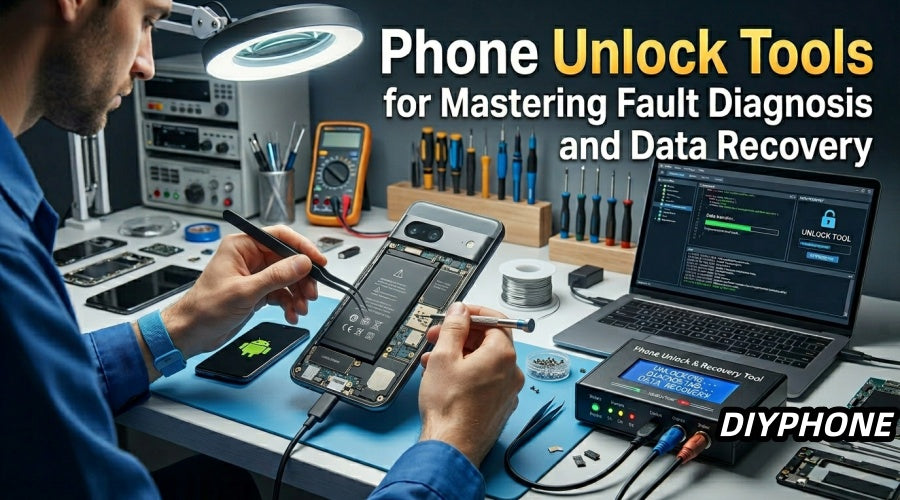
Beyond hardware disassembly, mobile phone repair often relies on controlling underlying system data and boot logic. DIYPHONE analyzes how repair technicians use phone unlocking tools to directly manipulate flash memory, system partitions, and boot configurations to resolve device faults stemming from physical damage or security policy restrictions.

I. Diagnostic Modes
The first step in repair is to place the device into an actionable logical state, namely DFU (Device Firmware Upgrade) or Recovery Mode. Many devices experience button failure due to drops, circuit shorts from water damage, or firmware corruption, making it impossible to enter flashing mode via standard button combinations.
1. Trigger Mechanisms and Signal Simulation
The MAGICO Restore Cables are essentially hardware signal simulators. By altering logic levels in the data transmission lines, they force the device to recognize a forced boot state.
· Repair Preparation: Before connection, use a multimeter to perform diode value testing on the device's charging port (dock connector) to rule out data transmission failures caused by physical damage to the port.
· Fault Scenario: The device fails to power on and shows no response when connected to a computer. In this case, a forced boot cable is used to bypass physical button logic and trigger the chipset's BOOTROM startup mode.
· Technical Difficulty: Pay attention to cable impedance matching. In some long-distance connections, insufficient power supply can lead to intermittent device recognition, preventing stable entry into the mode.
2. Security Permissions
For iOS devices, due to their highly closed sandbox mechanism, one must exploit boot vulnerabilities when handling account locks or abnormal system versions. Tools like J-BOX and C-BOX utilize these known vulnerabilities to inject temporary patches into the RAM, thereby obtaining temporary root access to the system.
· Core Application: These tools do not directly "unlock" the ID; instead, by obtaining underlying system permissions, they enable repair software to query and handle account configuration information stored in system directories. For devices with "Find My" enabled, as the activation lock verification occurs on Apple's servers, these tools are primarily used for system repair rather than bypassing activation. Technicians must accurately assess the device status to avoid repetitive, ineffective operations.

II. Underlying Configuration Data
When motherboard hardware components—such as the CPU, baseband, NAND, or Wi-Fi chip—are replaced, the system may block booting during the Power-On Self-Test (POST) phase. In such instances, underlying data tools are required for rectification.
1. Underlying Communication Logic
Taking the iRepair P10 DFU BOX as an example, this tool bypasses system-level driver verification to communicate directly with the flash memory chip via underlying protocols.
· Repair Mechanism: The Syscfg (System Configuration) of Apple devices contains serial numbers, model codes, region codes, and Wi-Fi/Bluetooth MAC address mappings. When a Wi-Fi module on the motherboard is replaced, the original address information no longer matches the new hardware, causing the system to trigger an error.
· Operation Points: A dedicated programmer interface must be used. First, enter diagnostic mode, read the original chip data, export it to a local backup, and then execute a data overwrite. It is critical to note that read/write protocol address offsets vary across different iOS versions; an incorrect offset can easily lead to the collapse of the flash memory data structure.
2. Thorough Data Cleaning in Refurbishment
During large-scale refurbishment, one must not only clear user data but also reset the flash memory's lifespan counters and bad block management tables. By rewriting Syscfg parameters through underlying tools and re-aligning the device baseband with the cryptographic chip (EEPROM), it ensures that the device can successfully pass Apple's online activation mechanism after flashing official firmware. The core of this process lies in simulating the initial configuration environment of the factory production line.

III. Chip Storage Programming and Repair
When a storage chip experiences severe physical bad blocks, logical partition corruption, or when the motherboard is so severely damaged that communication is impossible, chip-level hardware repair is mandatory.
1. NAND and UFS Protocols
Programmers such as the Flash NAND Programmer target the physical body of UFS, eMMC, or NAND chips, directly parsing the underlying communication protocols of the chips.
· Technical Background: UFS (Universal Flash Storage) significantly outperforms eMMC in transmission speed and energy efficiency, utilizing differential signal transmission. It internally contains Descriptors, Attributes, and Flags.
· Fault Repair Logic:
a. Desoldering: Using a hot air station adjusted to 350°C-380°C, supplemented by low-melting-point solder paste, gently remove the chip to avoid PCB delamination.
b. Chip Package Repair: After removal, use board cleaning fluid to remove residual glue and use a BGA reballing stencil to reball the chip, ensuring that every pin is conductive.
c. Configuration Reconstruction: When a programmer fails to read a chip, it is usually because the Descriptor is corrupted. In this case, one must manually load the corresponding configuration parameters based on the chip model (e.g., UFS 3.1 128G) to reset the chip's logical unit logic, allowing the chip to be driven by the motherboard's power management chip again.
2. RAW Data Extraction
For storage chips affected by water damage, some data sectors may be permanently unusable. Programmers support RAW mode reading, which bypasses the OS verification layer to directly extract underlying data blocks from the flash memory. By using software algorithms to reassemble the extracted fragments, it is possible to recover critical data such as photos and contacts from devices that will not power on.

IV. Application in Fault Diagnosis
The value of these tools lies not only in executing repairs but also in providing diagnosis through status words offered via the underlying interfaces.
1. Voltage and Current Curves
Utilizing the programmer interface, one can monitor the status of the NAND's VCC and VCCQ power supply pins in real-time. For instance, if the current spikes abnormally during data writing, it directly indicates a short circuit within the storage die. This diagnostic logic, based on current fluctuations, is more precise than visual inspection under a microscope for determining whether the storage medium or the control circuit is faulty.
2. System Log and Error Code Analysis
System logs read by unlocking tools contain detailed reasons for device resets. For example, an error code indicating NAND_ERR_B_READ explicitly points to bad blocks in the flash memory, preventing technicians from blindly flashing the device. For faults caused by bad blocks, forced flashing can permanently destroy the storage partitions.
3. Data Security Policy
In complex repair environments, protecting customer privacy and data security is an industry bottom line.
· Non-Destructive Data Reset
Using underlying tools to directly clear partition tables instead of performing a full-device overwrite allows for the thorough erasure of sensitive information in storage areas while maintaining the integrity of core system files. This approach is particularly important for second-hand device refurbishment, ensuring compliance during secondary circulation.
· Technical Logic for Minimizing Disassembly
Through non-disassembly programming tools, unnecessary thermal treatment of the motherboard is reduced. Each heating cycle risks causing micro-cracks in the PCB layers or loosening solder balls on other chips, which can lead to secondary faults.
In conclusion, mobile phone repair is a precise technology built upon underlying communication protocols, flash memory physical construction, and system boot logic. Whether performing forced identification via boot cables or chip-level underlying repair via programmers, every operation of these Mobile Repair Tools constitutes a deep intervention into the underlying logic of the mobile device. Understanding and mastering the underlying operational mechanisms of these tools is the core guarantee for performing high-difficulty motherboard repairs and data recovery.


