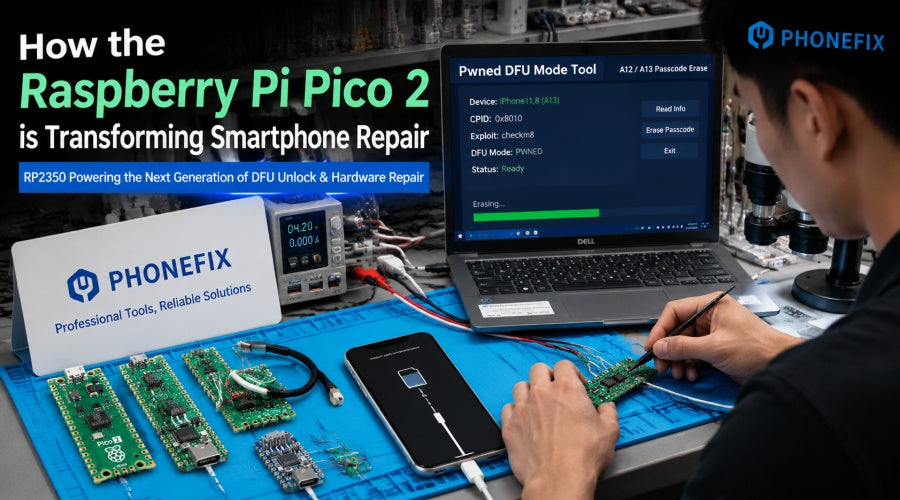
As smartphone security mechanisms continue to evolve, the mobile device repair industry is undergoing a profound technological shift. Traditional repair methods have largely been limited to screen replacements, battery swaps, or basic peripheral fixes; however, addressing complex chip-level hardware faults, firmware locks, and low-level data recovery requires engineers to delve into SoC-level communication and hardware vulnerability exploitation.

I. Why are the RP2350 and Pico 2 Driving the Smartphone Repair Revolution?
In the fields of mobile device repair and hardware-based unlocking, precise timing for signal control and bus communication is critical. For instance, executing low-level hardware exploits—such as USB stack overflows or glitch pulse injections—often demands nanosecond-level precision. Traditional microcontrollers or standard USB adapters often fail to meet these requirements due to performance limitations or uncontrollable latency, frequently resulting in failed exploits or even permanent chip lockouts.
The arrival of the RP2350 chip offers an ideal solution to these challenges:
1. High-Performance Dual-Core Architecture: Supports seamless switching between ARM Cortex-M33 and RISC-V cores, handling complex logic algorithms and firmware payload transmission with ease.
2. Flexible PIO and Native USB Interface: Engineers can use the Programmable I/O (PIO) subsystem to emulate custom serial communication protocols, enabling precise triggering of Device Firmware Update (DFU) modes and signal handshaking.
3. Versatile Form Factors for Diverse Scenarios:
· Raspberry Pi Pico 2 2W (Wi-Fi & Bluetooth): Ideal for laboratory environments or complex test benches, allowing engineers to deploy remote automated test scripts or wireless status monitoring.
· RP2350 USB-A Mini Development Board: Highly compact and plug-and-play for field repairs, eliminating complex wiring by plugging directly into a PC or testing rig.
II. Practical Application: DFU Passcode Erasure for A12/A13 Devices
In Apple device repair, devices powered by A12 and A13 chips often require low-level "Pwned DFU" mode to erase the passcode when standard system restore is not feasible. This process relies on specialized hardware DFU adapters to facilitate low-level signal handshaking and state switching.
1. Supported Device List
· A12 Chipset Devices: iPhone XS, iPhone XS Max, iPhone XR, iPad Mini 5, iPad Air 3, iPad (8th Generation)
· A13 Chipset Devices: iPhone 11, iPhone 11 Pro, iPhone 11 Pro Max, iPhone SE (2nd Generation)
2. Key Hardware Requirements
This workflow operates when the supported device is connected via a compatible hardware adapter. Using a purpose-built "Pwned DFU Mode Adapter for Apple A12 A13 DFU PASSCODE Erase" ensures stable DFU handshaking and exploit-based booting.

III. Standard Procedure for A12/A13 DFU Passcode Erasure
The following outlines the general repair workflow utilizing the hardware adapter and Windows-based software:
Step 1: Prepare the Hardware and Software Environment
1. Download and extract the software package on your Windows repair workstation.
2. Prepare a compatible DFU mode adapter and a high-quality data cable.
Step 2: Connect the Device to the Hardware Adapter
1. Connect the target device to the DFU adapter.
2. Plug the other end of the adapter into the computer's USB port.
Step 3: Boot the Device into DFU Mode
Manually boot the device into DFU mode using the specific button sequence for the target model. The adapter's built-in control chip will monitor and stabilize the bus status.
Step 4: Run the Software and Check Status
1. Launch the tool on Windows as Administrator.
2. The software scans for connected devices and reads the CPID (Chip ID) and exploit status.
Step 5: Perform Passcode Erasure
1. Confirm device recognition and adapter status.
2. Initiate the erasure process through the software interface.
3. Maintain a stable connection while the software completes the configuration reset.
4. Once completed, the device reboots to the setup screen.
From RP2350-based Pico 2 series micro-development boards to dedicated hardware adapters, open-source technology is empowering modern mobile phone repair—reducing costs and increasing repair success rates. To do a good job, one must have the right tools. Visit China Phonefix to purchase professional repair toolkits and cutting-edge hardware to boost your repair workshop's efficiency!