
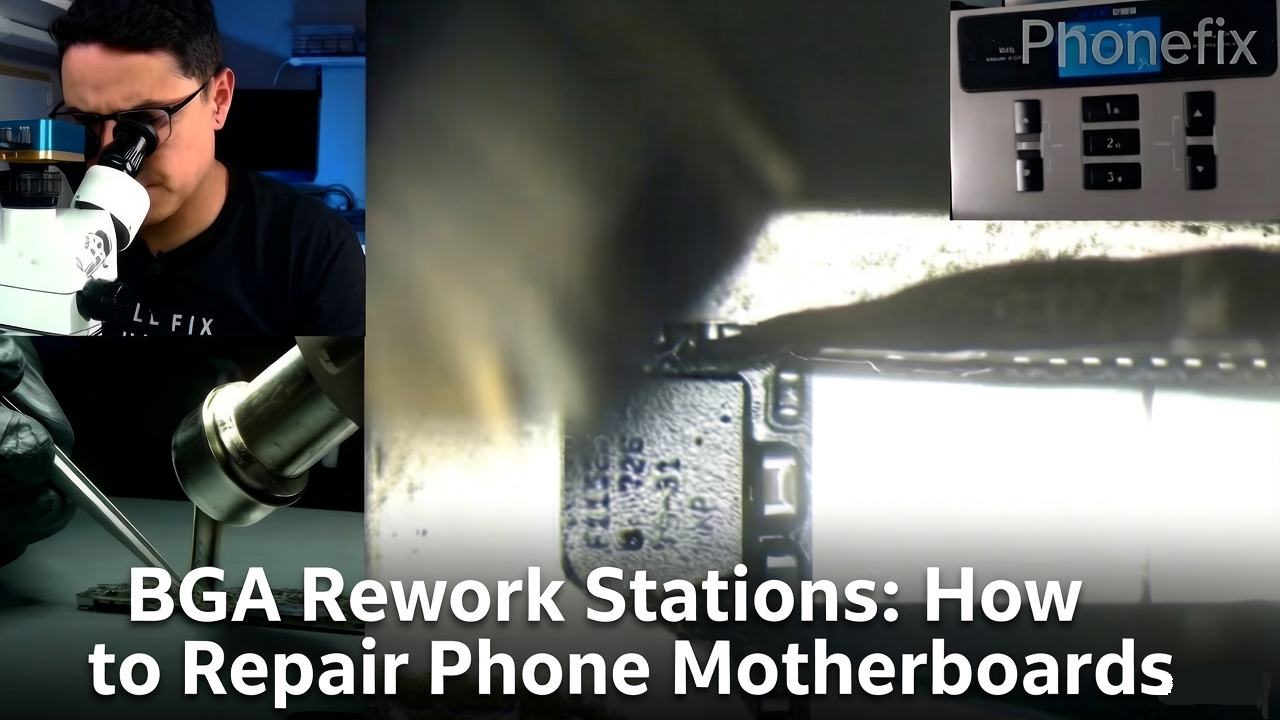
Modern smartphone motherboards feature highly integrated components that are susceptible to damage from physical drops or thermal stress. When critical chips suffer from fractured joints or failure, targeted micro-soldering becomes necessary to restore device functionality. Performing these advanced hardware interventions requires high-level precision that standard handheld tools cannot reliably provide. This article will systematically explain the technical principles, equipment benefits, and step-by-step procedures for successfully repairing mobile circuit boards using professional BGA hardware.

I. What Is a BGA Rework Station?
A Ball Grid Array (BGA) rework station is a specialized electronics repair machine designed to install, remove, and repair surface-mounted devices that use BGA packaging. In modern smartphones, major integrated circuits—such as the Central Processing Unit (CPU), NAND flash memory, Power Management IC (PMIC), and baseband processors—are universally packaged in BGA format. Instead of traditional pins on the perimeter, BGA chips utilize an array of microscopic solder spheres underneath the component to establish electrical connections with the Printed Circuit Board (PCB). Because these connections are entirely hidden beneath the chip, standard soldering tools cannot access them.
A professional BGA Rework Station integrates three core functional systems to safely manage these hidden solder joints:
· Heating System: It provides controlled hot air or infrared heat to the target chip. While high‑end models may include an independent bottom preheater to warm the entire motherboard, many professional‑grade stations focus on a powerful, precisely adjustable top heater which is sufficient for mobile phone PCB repair.
· Temperature Control System: This system monitors and regulates heat using a closed‑loop sensor (such as a thermocouple) with zero‑crossing triggering. It allows the operator to set and store multiple working channels with independent temperature and airflow parameters. Advanced temperature profiling is a feature found on more sophisticated units, but a stable, adjustable, and responsive closed‑loop control is the essential requirement for professional work.
· Alignment System: Precise chip placement is critical for BGA rework. While advanced rework stations may include an optical alignment mechanism, many professional setups achieve micrometer‑level accuracy using a separate microscope or stereo zoom magnifier in combination with steady manual tweezers. Thus, the alignment system can be either integrated or externally provided by the user's workspace.
Additionally, a professional BGA rework station often features an automatic cooling/sleep function to protect the heating element, a magnetic switch for real‑time operation, and a brushless vortex blower for adjustable airflow. These characteristics are common in modern hot air rework stations used for mobile phone motherboard repair.
II. Why Mobile Repair Technicians Need a BGA Rework Station
Repairing modern smartphone motherboards presents severe technical challenges due to component density and structural fragility. When a phone suffers from dropped solder joints, internal cracks, or chip failures, technicians must replace or re-solder the affected BGA IC. Relying on basic repair tools for these tasks introduces significant risks.
Limitations of Standard Hot Air Guns
Standard handheld hot air guns lack uniform heat distribution and precise temperature feedback. The air pressure can easily blow adjacent miniature resistors or capacitors out of place. More critically, manual hot air guns present a high risk of localized overheating. If the top of the chip absorbs excessive heat while the bottom of the PCB remains cold, the massive thermal gradient causes the thin smartphone motherboard to warp or bend. This thermal stress destroys the internal traces of multi-layer PCBs, rendering the phone permanently unrepairable.
Core Benefits of a BGA Rework Station
· Precision Temperature Profiles: Lead-free solder used in modern phones requires temperatures up to 217°C to melt, while the absolute thermal limit of the silicon chip is often around 260°C. A BGA rework station controls the heat within a tight margin, ensuring the solder melts fully without overheating the sensitive silicon layers inside the IC.
· Repeatable Success Rates: By saving specific temperature profiles for different smartphone models, the desoldering and soldering processes become scientific and highly repeatable, removing human error from the heating equation.

III. How to Use a BGA Rework Station: Step-by-Step
1. Preparation and Protection
Before placing the motherboard onto the machine, the technician must prepare the work area. If the target chip is surrounded by underfill, this glue must be carefully scraped away using a specialized blade under a microscope at a safe, low temperature (around 150°C).
Next, nearby sensitive components—such as plastic connectors, camera sockets, and adjacent unshielded ICs—must be protected. The technician applies heat-resistant tape or metallic thermal shielding tape over these areas to block stray heat.
2. Chip Desoldering and Removal
The technician selects the appropriate lead-free temperature profile on the machine's control panel. A standard profile consists of four distinct phases:
· Preheating Phase: Gradually raises the board temperature to evaporate any moisture and reduce thermal shock.
· Soak Phase: Equalizes the temperature across the board and activates the flux.
· Reflow Phase: Quickly ramps up to the peak temperature (typically between 235°C and 245°C) to melt the lead-free solder balls underneath the chip.
· Cooling Phase: Lowers the temperature safely.
During the peak reflow phase, when the solder turns liquid, the technician uses the machine's integrated vacuum pickup pen or a pair of high-precision tweezers to lift the chip vertically off the board. Horizontal movement must be completely avoided to prevent tearing the delicate copper pads on the motherboard.
3. Cleaning and Reballing
Once the chip is removed, residual old solder remains on both the motherboard pads and the underside of the IC. The technician applies a layer of high-quality flux paste and uses a temperature-controlled soldering iron along with a copper desoldering wick to gently absorb the remaining solder. The surfaces must be cleaned with PCB cleaner (isopropyl alcohol) until they are completely flat and smooth.
To reuse the chip, it must undergo reballing. The technician places the cleaned chip into a dedicated high-precision BGA Reballing Stencil that matches the chip's pad layout. Solder paste is spread evenly across the stencil holes. Using a controlled heat source, the paste melts and forms perfect, uniform solder spheres on each pad of the chip.
4. Precision Alignment and Soldering
The technician applies a thin, uniform layer of tacky flux to the clean motherboard pads. If using an optical alignment system, the prism is moved into position between the chip and the board. The technician uses the adjustment knobs to align the yellow dots (solder balls on the chip) with the blue dots (pads on the board) on the monitor screen.
Once alignment is perfect, the machine places the chip down onto the board. The technician then runs the reflow soldering profile. As the temperature reaches the melting point, the surface tension of the molten solder creates a self-alignment effect, pulling the chip into its precise final position.
5. Cooling and Inspection
After the heating cycle finishes, the cooling fans activate to lower the temperature at a controlled rate, ensuring the new solder joints crystallize without developing cracks. The motherboard is then removed from the fixtures.
The technician inspects the perimeter of the chip under a microscope to verify that the solder spheres are uniform and that no bridging (short circuits) has occurred. Finally, a digital multimeter is used to measure the ground resistance of the power rails. If no short circuits are detected, the motherboard is reassembled into the phone chassis for power and functional testing.

Adhering to these calibrated steps ensures consistent structural integrity across all localized solder joints. Standardizing these heating profiles minimizes thermal degradation of the silicon, extending the operational lifespan of the repaired hardware. Understanding and mastering this process requires patience, proper training, and reliable Phone Repair Tools, organically leading to professional-grade results in modern micro-electronics maintenance.


