
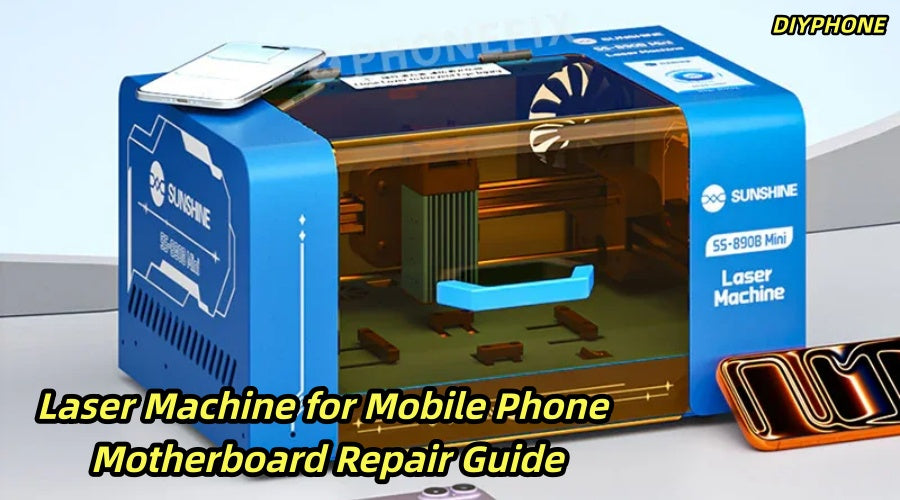
All the mobile repair shop owner know that CPU pseudo-soldering and solder pad detachment are common faults. Traditional hot air guns have a large heating area, easily affecting surrounding components; soldering irons struggle with dense BGA solder joints. A faulty phone often required motherboard replacement in the past, with high repair costs. The application of laser machines provides an alternative solution for such faults.

I. Technical Characteristics
laser machine focus laser beams into extremely small areas through focusing lenses, causing solder to melt rapidly to complete welding. This non-contact heating method has several distinct differences compared to traditional tools.
1. Small Heat-Affected Zone
Mobile phone motherboards have high component density, with 5G chips, power management ICs, and other components often spaced less than 1 millimeter apart. Hot air gun heat flow diffuses, easily causing adjacent components to shift or plastic parts to deform. The heat-affected zone of Laser Machines can be controlled within 0.5 millimeters. When repairing middle-layer solder joints in double-layer motherboards or power ICs, extensive thermal insulation protection of surrounding areas is unnecessary.
2. Adjustable Energy Parameters
Equipment generally features power adjustment and pulse modes, allowing different outputs based on solder pad size. When welding middle-layer solder joints in double-layer motherboards, pulse mode can penetrate upper board holes to reach target positions directly; continuous heating mode is suitable for re-tinning large-area ground solder pads. The same device can adapt to different scenarios such as fingerprint flex cable welding and CPU reballing.
3. Non-Contact Reduces Physical Damage
Soldering iron tips suffer from oxidation and wear, and improper operation can scratch PCB solder mask layers. Llaser machines are entirely non-contact, making them friendly to thin motherboards or flexible circuit boards. When repairing foldable phone hinge flex cable solder joints, the risk of flex cable substrate curling from heat can be reduced.
In actual operation, use with high-magnification stereo microscopes is required. Repair technicians observe laser targeting and solder flow status at 15x to 40x magnification, confirming that molten solder wets the pad without overflowing. The microscope's cold light source ring light also reduces eye fatigue during extended operations.

II. Repair Process
Taking an Android phone CPU pseudo-soldering failure causing no power-on as an example, the standard repair process is described below.
1. Fault Diagnosis and Board Removal
For a device received for repair that repeatedly restarts and occasionally freezes after entering the system, first rule out software issues, identifying CPU pseudo-soldering or motherboard broken traces. Remove the motherboard, use board cleaner to remove factory black adhesive and thermal paste, exposing the CPU shielding cover. Use a precision hot air station at 180°C low temperature to soften shielding cover solder, removing with tweezers—the hot air station is used here for auxiliary disassembly, not for processing core solder joints.
2. Laser Desoldering and Pad Cleaning
Fix the motherboard on the laser machine workbench, adjust the CCD monitor for clear imaging of the CPU pad area. Set power to 60W, pulse frequency to 5Hz, laser beam scans row by row across pads, after old solder melts, remove residue with a vacuum desoldering pen. Controlling scan speed is critical—too fast leaves solder uncleaned, too slow causes substrate carbonization. After cleaning, use copper braid with flux to wipe away oxidation layers.
3. Reballing and Laser Reflow Soldering
Re-apply solder balls on CPU chip or motherboard pads, ball diameter typically 0.25mm or 0.3mm, must match factory BGA matrix. After chip alignment with motherboard pads, laser machine switches to continuous mode, power adjusted to 80W, scanning from outside inward in concentric circles. After solder balls melt, they automatically align under surface tension. The entire process takes approximately 90 seconds, shorter than hot air gun heating time, with less overall motherboard heating.
In mobile phone motherboard repair, CPU pseudo-soldering and solder pad detachment are common faults. Traditional hot air guns have a large heating area, easily affecting surrounding components; soldering irons struggle with dense BGA solder joints. A faulty phone often required motherboard replacement in the past, with high repair costs. The application of laser soldering stations provides an alternative solution for such faults.

III. Impact on the Repair Industry
1. Changes in Technical Learning Paths
In the past, CPU-level repair relied on long-term tactile experience accumulation, including soldering iron temperature control, hot air gun wind speed and distance coordination. laser machine transform some operations into quantifiable parameters; after standardized training, beginners can master basic operations in relatively short time. However, fault diagnosis capability, underlying understanding of parameter adjustment, and comprehensive judgment of complex situations still require accumulation.
2. Continuity of Technical Updates
laser machine themselves are also updating; some new models integrate temperature feedback systems, monitoring solder joint temperature in real-time through infrared sensors and automatically adjusting power. Repair technicians need to continuously follow equipment upgrades and process changes, such as irregular-shaped soft board welding for foldable phones and other technologies that may also penetrate the mobile phone repair field.
Different tools each have their applicable scenarios; only good mobile phone repair tools can guarantee repair quality. From hot air guns to laser machine, Phone Repair Tools in this industry are gradually becoming more refined. The purpose of updating technical tools is to restore device functions within controllable ranges and reduce user losses.


