
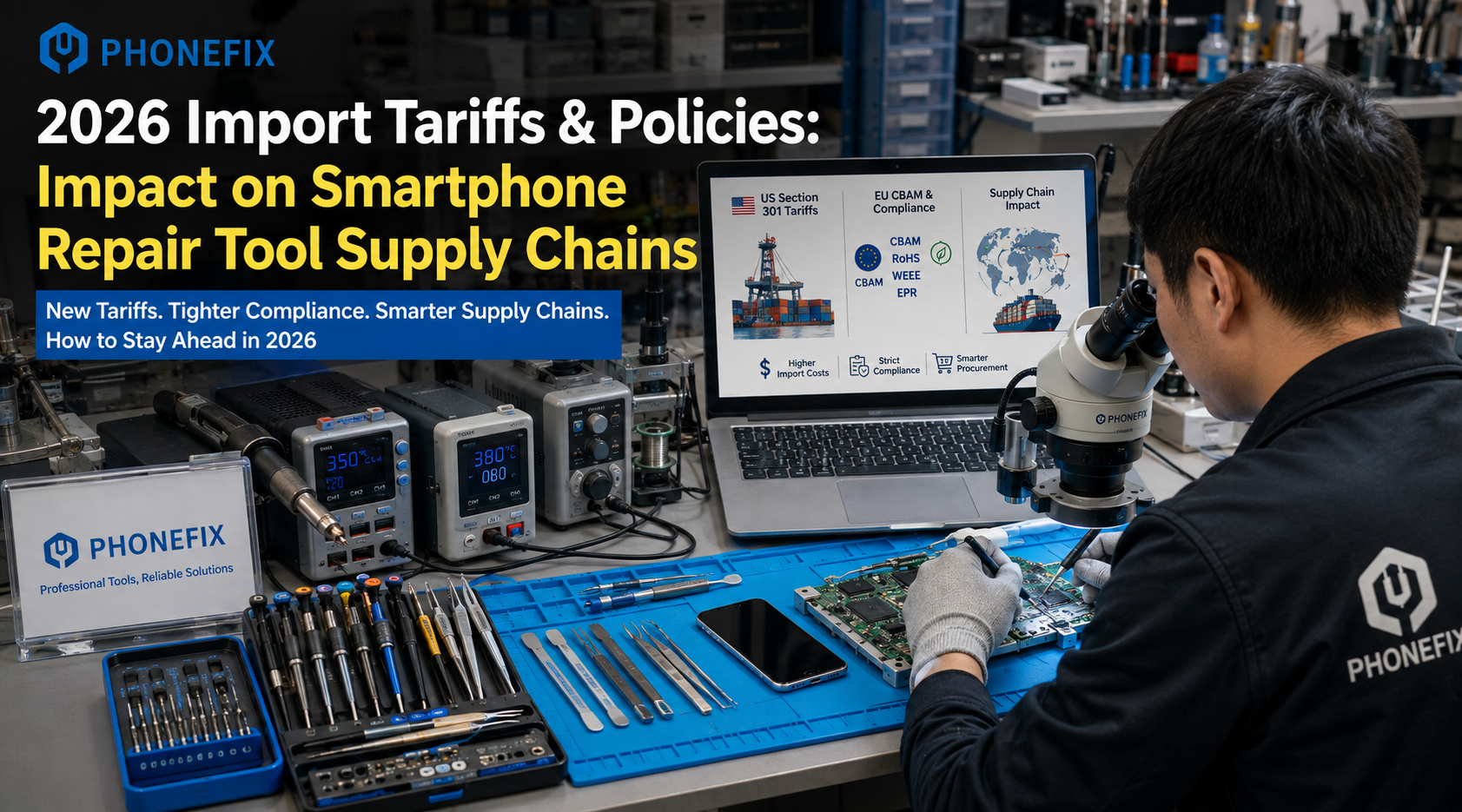
With the continued growth of the global electronics repair and recycling market, precision repair tools made in China are highly favored in European and American markets due to their high quality, well-established supply chain, and cost-effectiveness. Entering 2026, US tariff policies, EU CBAM and RoHS, WEEE, EPR and other compliance requirements continue to escalate, posing new cost and compliance challenges to the supply chain. Overseas repairers, wholesalers, and cross-border sellers need to reassess their procurement costs and supply strategies.

I. Analysis of the Latest European and American Tariff and Compliance Policies
1. The Continued Deepening of the US Section 301 Tariff Policy
The tariffs imposed by the United States on Chinese goods under Section 301 of the Trade Act of 1974 cover a large number of hand tools, power tools, and electronic testing instruments. With the dynamic adjustment of policies, import tariff rates involving hardware and precision electronic components remain high. This directly leads to US importers and wholesalers having to pay additional tariff surcharges during customs clearance, significantly increasing end-user procurement costs.
2. The Dual Impact of EU CBAM and New Environmental Compliance Regulations
In its green transition, the EU is continuously raising the compliance threshold for imported products:
· Carbon Border Adjustment Mechanism (CBAM): While initially focusing on basic raw materials such as steel and aluminum, as regulations extend downstream, the carbon footprint certification and reporting requirements for high-metal-content precision tools and heating equipment at the production end are becoming increasingly stringent.
· CE and RoHS/REACH Directive Upgrades: For electrical instruments such as welding equipment and heating tables, the EU has introduced stricter lead-free environmental certification requirements and electronic safety directives.
· Extended Producer Responsibility (EPR) and Packaging Compliance: Importers are required to complete local registration for the recycling of Waste Electrical and Electronic Equipment (WEEE) and packaging waste, increasing compliance audit costs and operational complexity.
II. Specific Impacts of Tariffs and Compliance Barriers on Four Core Repair Tools
Faced with escalating trade barriers from the US and Europe, different categories of precision repair tools have been impacted to varying degrees in terms of cost, customs clearance, and supply chain:
1. Precision Screwdrivers & Hand Tools
Basic hand tools such as precision screwdrivers, bit sets, metal pry bars, and tweezers primarily involve the processing of high-hardness alloy steel and aluminum profiles. Because these products are included in the hardware tool tariff list, and the EU has increased its requirements for the traceability of raw materials for metal products, the traditional low-price, high-volume export model has been significantly impacted.
To reduce import costs and ensure smooth customs clearance, overseas buyers are increasingly inclined to purchase high-end products that have undergone rigorous quality inspection, have clear material markings, and are more durable, such as DIYFIX Precision Screwdrivers & Opening Tools, thereby reducing repeated tariff expenditures due to frequent tool replacements.

2. Soldering Stations & Micro-Soldering Gear
Intelligent temperature-controlled soldering stations, hot air desoldering stations, and micro-soldering equipment are core equipment for chip-level repair of smartphone motherboards (such as flywire repair and pad re-soldering). These tools not only face high tariffs but also need to meet the EU's mandatory certifications for electromagnetic compatibility (EMC), low voltage directive (LVD), and lead-free environmental protection (RoHS).
Increased compliance costs make it difficult for low-end, uncertified products to enter the European and American markets. Overseas professional repair organizations have to find alternatives that possess international safety certifications, precise temperature control, and cost-effectiveness. Purchasing high-performance DIYFIX Soldering Stations & Rework Systems can effectively ensure repair quality and avoid the risk of customs seizure due to equipment compliance deficiencies.
3. Heating Platforms & Screen Separators
Temperature-controlled heating platforms and constant-temperature disassembly instruments used for screen separation, back glass removal, and motherboard preheating are high-power electronic heating devices. In the latest European and American import and export compliance reviews, customs has raised higher requirements for the power efficiency, temperature control safety, and carbon emission traceability of such equipment.
Tariffs combined with compliance costs have increased the final selling price, forcing repair service providers to carefully calculate the return on investment (ROI) of their equipment. DIYFIX Heating Stations & Screen Separators, featuring intelligent PID constant temperature control, uniform heating, and energy efficiency, are becoming an ideal choice for overseas customers to balance cost and efficiency.
4. Microscopes & Diagnostic Instruments
High-precision instruments such as trinocular continuous zoom microscopes, thermal imaging camera, and motherboard fault detectors are high-value-added export products. Due to tariff increases, the absolute value of import taxes per instrument has increased significantly.
For B2B procurement decision-makers, when purchasing such high-value equipment, they prioritize whether the supplier has complete export qualifications and certifications and the resilience of the supply chain. Obtaining high-definition and stable, durable inspection equipment through DIYFIX Inspection Microscopes & Diagnostic Tools can minimize the secondary import costs caused by product quality defects.

III. Strategies for Overseas Buyers and Repair Shop Owners
Faced with policy uncertainties, overseas B2B buyers and repair shop owners do not need to passively bear rising costs. They can effectively mitigate these risks through the following strategies:
1. Optimize Procurement Structure and Choose High-Performance, Compliant Brands
Simply pursuing low prices is no longer sufficient in the current tariff and compliance environment. Choosing direct-supply brands like DIYFIXTOOL, which specialize in repair tools and possess comprehensive quality control and export qualifications, can reduce product defect rates at the source and avoid additional tariffs and logistics costs incurred due to repeated returns and exchanges.
2. Centralized Bulk Procurement and Supply Chain Planning
Reasonably predict quarterly demand and adopt centralized procurement and bulk shipping methods to spread out customs clearance fees and cross-border logistics costs per unit. Simultaneously, cooperate with professional suppliers with cross-border compliant customs clearance capabilities to ensure the accuracy of customs documents (such as HTS code classification, CE/RoHS certificates) and avoid demurrage fees and penalties.
3. Enhance the Added Value of Repair Services and Balance Tool Procurement Costs
By introducing more precise soldering and testing instruments and expanding high-profit service items such as motherboard-level repair and data recovery, the revenue from high-value-added repair services can offset the slight increase in tool import costs, achieving a virtuous cycle of business growth and cost control.
While the Section 301 tariffs and new import/export compliance regulations such as CBAM in Europe and the US have brought short-term cost challenges to the export of Chinese precision electronic repair tools, they have also accelerated the survival of the fittest and quality upgrades within the industry. With its strong R&D capabilities, rigorous quality control, and high cost-performance advantage, high-quality Chinese precision tools remain an indispensable core support for the global electronics repair industry. China Phonefix is committed to providing global customers with professional, compliant, and cost-effective one-stop electronic repair tool solutions, helping you easily cope with supply chain challenges and achieve long-term business development.


