
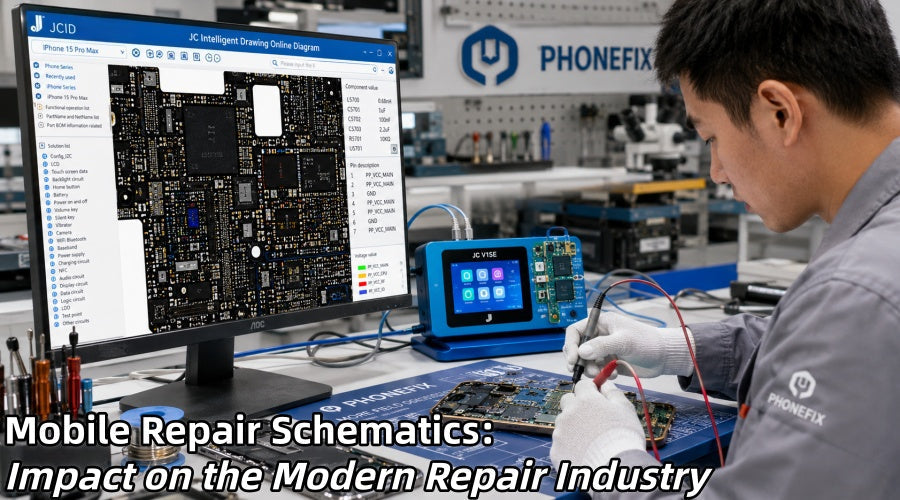
In today’s fast-evolving smartphone industry, mobile repair schematics are transforming phone repair from a trial-and-error trade into a precise, component-level repair system. Combined with advanced digital diagnostic tools, schematics significantly improve fault detection efficiency while reshaping the modern smartphone repair industry.
I. Precision Over Guesswork: From "Blind Repair" to Chip-Level Diagnostics
In the past, when repair technicians encountered common smartphone malfunctions—such as device freezes, charging failures, or backlight issues—they often relied on visual inspections or the indiscriminate replacement of components. However, the internal structure of modern smartphone Printed Circuit Boards (PCBs) is incredibly complex, densely packed with countless tiny capacitors, resistors, and integrated circuits (chips).

By utilizing digital intelligent schematics—such as the JC Intelligent Drawing Online Diagram Bitmap and the Online Drawing XZZ Schematic Diagrams Tool—technicians are endowed with a "penetrating vision" that allows them to see deep into the motherboard's internal architecture. These tools provide not only precise circuit layouts, voltage values, and signal pathways, but their unique "Bitmap" function also clearly visualizes the intricate routing structures hidden within the motherboard's internal layers.
· Precise Localization: Technicians can trace a signal source with a single click, allowing them to pinpoint damaged capacitors or severed circuit lines with absolute precision.
· Mastering Micro-soldering Challenges: On ultra-high-density PCBs, schematics make complex micro-soldering operations feasible. Whether repairing a short circuit on a logic board or salvaging a device suffering from severe liquid damage, technicians can now tackle these challenges with confidence—without the need to simply discard and replace the entire motherboard.
II. The Fusion of Efficiency and Versatility: Synergies in Smart Hardware
Modern device repair is no longer an isolated battle fought with a single schematic; rather, it represents a deep synergy between "software schematics" and "hardware programmers." The emergence of modern intelligent devices—such as the JC V1SE Programmer (a multi-functional repair tool)—perfectly completes the puzzle of data-level repair within the hardware domain.
Once technicians have identified circuit logic and repaired physical connections—typically using tools like JC Intelligent Drawing or XZZ Schematic Diagrams—they often encounter issues related to "component encryption" or "data loss" inherent in modern smartphones (such as data matching for screen color temperature, Face ID, battery health status, etc.). At this juncture, integrating the JC V1SE Programmer to read, back up, and write underlying data creates a perfect closed loop that seamlessly bridges the gap between hardware and software.

Core Benefits: Dual Optimization of Time and Cost
· Reduced Troubleshooting Time: Detailed circuit board views and real-time updated online schematics allow troubleshooting tasks—which might otherwise take hours or even days—to be completed within minutes.
· Increased Profit Margins: Significantly lower labor costs combined with a marked improvement in repair turnaround rates directly drive profit growth for repair centers.
III. Promoting Industry Equity
For a long time, the monopoly held by official after-sales service providers over core technical documentation placed independent repair shops at a competitive disadvantage. However, the widespread adoption of advanced online schematic tools—such as those offered by XZZ and JCID—has emerged as a powerful technical pillar supporting the realization of the "Right to Repair" initiative.
· Breaking Down Technical Barriers: Open, transparent, and easily accessible circuit diagrams empower independent repair shops with chip-level repair capabilities that equal—or even surpass—those of manufacturer-authorized service centers.
· Benefiting Consumers: Healthy industry competition provides consumers with more affordable, convenient, and efficient non-official repair options; this extends the lifecycle of electronic devices and contributes positively to environmental sustainability.
IV. Technological Evolution and Future Outlook
The integration of modern schematic data with cutting-edge technology is propelling the mobile phone repair industry into an entirely new, intelligent era:
1. AI-Assisted Diagnostics: Modern repair software is beginning to cross-reference schematic data with vast datasets of historical repair cases and failure patterns. Aided by artificial intelligence, this software can now accurately predict and recommend the specific components most likely responsible for a fault, based directly on the symptoms reported by the user.
2. Automated Mechanical Integration: Specialized machinery—such as Tool for screen separation, chip grinding, or laser-assisted screen removal—is increasingly relying on pre-programmed schematic data to execute precise operations. By relying on the precise coordinates provided in technical drawings, automated tools can ensure the uniform application of heat and pressure—or execute precise laser paths—thereby preventing damage to surrounding circuitry.

Industry Challenges
Although schematics are powerful tools, the reliance placed upon them imposes increasingly rigorous demands on practitioners. Technicians must undergo continuous, advanced training to interpret ever-more-complex circuit designs. Furthermore, manufacturers' constantly evolving anti-repair measures—such as software locks and the physical shielding of miniature components—remain significant obstacles.
Amidst the trend toward increasingly compact and complex electronic devices, the integration of advanced digital schematics with diagnostic equipment is no longer merely an option; it has become an imperative for repair businesses seeking to remain competitive. These specialized mobile repair tools not only enhance the precision and efficiency of repairs but also fundamentally reshape the ecosystem of the modern mobile device repair industry, making "chip-level precision repair" a widespread standard.


