
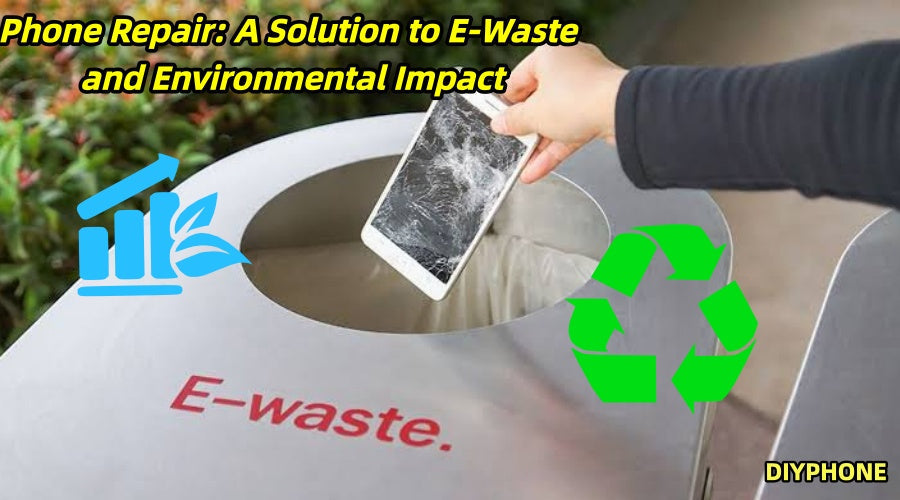
When you encounter a problem with your phone, do you choose to buy a new one or repair it? Rather than waiting until a phone becomes unusable and then considering how to recycle it, it is better to start by extending the product's lifespan and giving repair a more important role. The production of smartphones requires large amounts of metals, plastics, glass, and other rare materials. Once devices are discarded, they also generate enormous amounts of electronic waste, which undoubtedly causes environmental pollution.

I. Reasons Why Cell Phones Cause Environmental Pollution
Although smartphones appear to be very small, the production process behind them involves complex resource extraction, manufacturing, and global transportation. Therefore, their environmental impact goes far beyond the phone itself.
1. Production Requires Large Amounts of Resources
A cell phone contains gold, silver, copper, palladium, and various rare elements. These materials need to be obtained through mining and processing. Resource extraction not only consumes natural resources, but may also cause land degradation, water consumption, and increased energy use. More importantly, some key elements used in the manufacture of electronic products are relatively scarce. As the global number of smartphones and other electronic devices continues to increase, demand for these materials will also continue to grow. If products are used for too short a period, it means that new devices need to be produced continuously, thereby accelerating the consumption of natural resources.
2. Carbon Emissions from Manufacturing
The environmental impact of smartphones is mainly concentrated in the production stage. Raw material extraction, component production, assembly, and transportation all consume energy and generate carbon emissions. Therefore, when a phone that is still usable is discarded simply because of an aging battery, a damaged screen, or a faulty charging port, consumers are effectively creating another complete demand for the manufacture of a new product. A seemingly simple malfunction may therefore result in environmental costs far greater than those of the repair itself.
3. E-Waste Causes Resource Waste
The amount of electronic waste worldwide is continuously increasing. Although smartphones account for only part of it, they contain relatively valuable resources. Many discarded phones still contain metals and other materials that can be reused. If these devices do not enter a proper recycling system, they not only result in wasted resources but may also create environmental risks due to improper handling of electronic components and batteries. Therefore, the e-waste problem is not only a pollution issue but also an issue of resource-use efficiency.

II. Why Repair Should Be Prioritized
Recycling is certainly an important way to deal with electronic waste, but it usually takes place after a product can no longer continue to be used. In comparison, repair can directly extend a product's lifespan and should therefore become the first line of defense against e-waste.
1. Repair Can Reduce the Production of New Cell Phones
Many phone malfunctions do not mean that the entire phone has lost its value. For example:
· Aging battery: After a phone has been used for several years, its battery life may decrease significantly. Usually, only the battery needs to be replaced, rather than the entire phone.
· Damaged screen: If the screen develops cracks after an accidental drop, normal use can be restored by replacing the screen.
Faulty charging port: If the charging port has poor contact, the port itself can be repaired instead of immediately discarding the device.
· Damaged camera: A malfunctioning camera does not mean that the motherboard, battery, speaker, and other components have all lost their value.
If a phone can be restored to normal use through repair, there is no need to immediately purchase a new device simply because a single component has a problem.
2. Repair Can Preserve More Resources
A phone is usually made up of many components with different functions. For example, a malfunctioning camera does not mean that the motherboard, battery, speaker, and body have all lost their value; similarly, a problem with the charging port does not mean that the entire device must be discarded. The significance of repair lies in "repairing only what is broken" and preserving as many properly functioning parts as possible. Compared with directly replacing the entire phone, this approach can reduce the demand for new raw materials and prevent large numbers of still-usable components from entering the waste stream prematurely.
3. Repair Is More Consistent with the Circular Economy
The circular economy does not simply emphasize processing products after they become waste. Instead, it aims to keep products and materials in use for as long as possible. From the perspective of the product life cycle, a path can be formed: "reducing purchases — extending use — repair and refurbishment — reuse — final recycling." The focus here is not to eliminate recycling, but to adjust the priority of different stages. Recycling is an important measure at the end of a product's life cycle, while repair extends the product's lifespan when it still has use value. The two should form a complete circular system.

III. Problems Facing Smartphone Repair
Although repair has clear environmental value, many consumers still tend to replace their phones when they break. This is not only related to consumption habits, but also to the design of smartphones themselves, repair costs, and service systems.
1. Some Cell Phones Are Difficult to Repair
Modern smartphones are becoming increasingly thin and lightweight, while their internal components are also becoming more compact. In order to improve dust and water resistance and structural stability, some devices make extensive use of adhesive structures, making the removal of screens and batteries more complicated. For example, replacing an aging battery may first require a Screen Heating Separator to heat and soften the adhesive material, followed by gradually separating the screen.
During this process, attention must also be paid to flex cables and internal components. If the design itself is not conducive to disassembly, repairs require a higher level of technical skill and more time, ultimately increasing repair costs.Therefore, whether a phone is easy to repair does not depend only on whether it can be taken apart. It also depends on whether its internal structure is reasonable, whether vulnerable components can be easily replaced, and whether secondary damage is likely to occur during the repair process.
2. Spare Parts and Repair Information Are Not Easily Accessible
Repair requires appropriate spare parts, professional tools, and technical information. If manufacturers do not provide sufficient spare parts and repair instructions, third-party repair organizations may find it difficult to provide services. For ordinary consumers, even if the issue is simply a loose charging port, a damaged camera, or declining battery performance, it is difficult to determine the cause of the problem based solely on personal experience. The lack of transparent repair prices, reliable repair channels, and sufficient supplies of spare parts will further reduce people's willingness to repair their phones.
3. Lack of Awareness of Long-Term Use
Frequently replacing smartphones has gradually become a consumption habit. New products with better cameras, faster processors, or new designs can all encourage consumers to replace their devices. However, if a phone can still meet basic needs, replacing it simply because a new product has been released will further shorten the average lifespan of electronic products. When a phone develops a minor problem, first determining whether it can be repaired rather than directly purchasing a new device is also a more sustainable way of consumption.

IV. How to Promote Phone Repair
1. Improve Repair Services and the Right to Repair
Manufacturers can provide spare parts, repair tools, and technical information, giving consumers more repair options, such as replacing components such as the iPhone Batteries or screens. At the same time, measures such as repair subsidies and tax incentives can be used to reduce consumers' repair costs. Repairability ratings can also help consumers understand whether a product is easy to repair when purchasing a phone. In this way, repair would no longer be a service available only to a small number of professionals, but could gradually become an accessible option for ordinary consumers.
2. Product Design
Manufacturers can adopt more modular designs so that easily damaged components such as batteries, screens, and cameras can be independently removed and replaced. This can not only reduce the difficulty of repair but also prevent an entire phone from being discarded because of damage to a single component. At the same time, products should provide sufficiently long-term software update support. Even if the hardware is not damaged, the lifespan of a phone can still be shortened if it can no longer function properly because the system is no longer updated. Therefore, true repair includes not only replacing hardware but also extending the software life cycle.
3. Develop Refurbishment and Reuse
A repaired phone does not necessarily have to return to its original user; it can also enter the refurbished market. After inspection and the replacement of necessary components such as the battery or screen, the device can continue to serve other consumers. Manufacturers and retailers can also explore business models such as leasing, trade-ins, and phone-as-a-service, allowing companies to take greater responsibility for product recovery and reuse and thereby reducing the possibility of devices being discarded improperly.
V. Extending the Smartphone Life Cycle Through Repair
The core of the smartphone e-waste problem is not only "how to deal with the waste that has already been generated," but more importantly, how to reduce the rate at which waste is generated. Recycling can allow materials from discarded phones to re-enter the production system, but repair can prevent a phone that still has use value from becoming waste prematurely at an earlier stage.
Therefore, to address the environmental problems associated with smartphones in the future, a circular model centered on extending product lifespans should be established: starting with repairable product design, further maximizing product value through refurbishment and reuse, and only then entering the recycling stage. While reducing e-waste, the use of Mobile Repair Tools and correct repair procedures can effectively conserve resources, reduce carbon emissions, and promote the development of electronic products toward a more sustainable circular model.


