
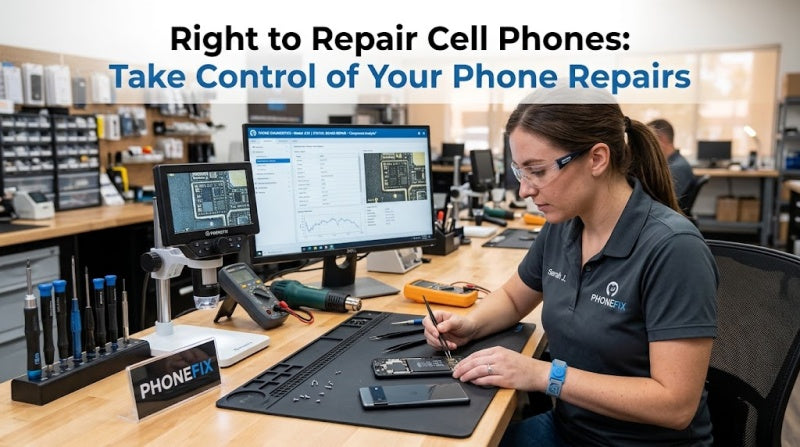
As consumers demand access to parts, tools, and repair manuals to repair their devices themselves, the "Right to Repair" movement is attracting increasing attention. Supporters argue that it helps improve affordability, sustainability, and ownership, while critics warn that it poses security and intellectual property risks.
I. Understanding the Right to Repair Mobile Phones
1. What Is the Right to Repair?
The core idea behind the right to repair mobile phones is simple: since consumers purchase and own a phone, they should have the right to repair it themselves or choose a third-party repair service provider they trust, rather than having to rely solely on repair channels designated by the manufacturer.
This right means more than simply being able to open a phone and replace parts. It also includes access to repair manuals, the use of necessary diagnostic tools, the ability to purchase compatible replacement parts, and an understanding of repair prices and warranty terms. True freedom of repair means giving users reasonable choices rather than turning repairs into a technical and commercial barrier that is difficult to overcome.

2. Why Is Mobile Phone Repair Becoming Difficult?
In the past, some electronic devices had relatively simple structures, and people with basic tools and repair knowledge had the opportunity to replace batteries or repair components. Today, to achieve slim designs, water resistance, and high performance, mobile phones generally feature compact internal layouts, Strong Bracket Glue, and highly integrated components.
3. Other Issues
Some devices are also subject to restrictions such as component serial number pairing, software verification, or specialized diagnostic tools. Even when a replacement part has the appropriate specifications, repairs may still result in limited functionality, warning messages, or an inability to complete calibration. As a result, repair difficulty no longer depends solely on technical skills but is also influenced by software, supply chains, and commercial rules.
II. Why Does Mobile Phone Repair Matter?
The right to repair is not just about helping users save money on repair costs. It is also related to consumer autonomy, market competition, and the sustainable development of electronic products.
1. Advantages of the Right to Phone Repairs
· Reducing repair costs: For phones that only need a battery, screen, or other small component replaced, proper repairs are often more economical than purchasing a new device.
· Promoting market competition: Opening up access to parts and repair information allows more independent repair shops to compete, offering consumers services at different price points.
· Improving price transparency: When consumers can compare prices and service quality across different repair channels, they can make choices more easily based on their budgets and actual needs.
2. Consumer Ownership Rights
Purchasing a phone should not mean that all repair decisions must subsequently be controlled by the manufacturer. If a phone loses some of its functionality simply because a third-party part is installed, or if users worry that their warranty may be affected merely because they choose independent repair services, then product ownership has its limitations.
Of course, the right to repair does not mean that every repair must be approved. If a third party causes damage through its work, the manufacturer should still be able to determine responsibility according to reasonable and clear terms. However, users should not be deprived of other warranty rights that would otherwise remain valid simply because they choose a compliant independent repair channel.
3. Reducing Electronic Waste
Manufacturing mobile phones consumes metals, plastics, energy, and other resources. For example, when an iPhone is discarded prematurely, particularly because of a component such as iPhone battery, more electronic waste is generated, while the resources and energy required to manufacture a replacement are consumed again. By lowering the barriers to repair, the right to repair encourages consumers to consider repairing devices before replacing them, making product lifespan extension a more realistic option.

III. The Trend Toward DIY Repairs
As consumers pay increasing attention to repair autonomy, mobile phone repair is gradually shifting from a traditional after-sales service issue to a broader topic involving product design, software management, and consumer rights.
1. More Diverse Repair Service Models
· Self-service repairs: More and more consumers want manufacturers to provide original replacement parts, repair guides, and necessary technical support. Some manufacturers have also begun exploring self-service repair programs that allow users to purchase parts and tools themselves and complete certain repairs by following official procedures.
· Independent repair channels: When repair parts and technical information become easier to obtain, consumers can choose between personal DIY repairs, third-party repair shops, and official after-sales services. The repair market may also develop more robust competition.
· Open resources: Providing parts does not necessarily mean that true repair freedom has been achieved. If tools are too expensive, repair procedures are overly complicated, or key functions remain restricted by software, DIY repairs will still be difficult to popularize.
Therefore, the accessibility and affordability of repair resources are also important criteria for evaluating the right to repair.
2. Software Restrictions Have Become a New Key Issue
Modern mobile phones are no longer merely hardware products. They are digital devices made up of operating systems, firmware, and various verification mechanisms. After a repair is completed, certain components may need to be calibrated or reverified before their full functionality can be restored.
Necessary verification helps ensure device security and operational stability. However, if verification mechanisms are designed to accept only parts supplied through specific channels, they may unnecessarily restrict repair options. In the future, the right to repair will involve more than simply allowing users to open their phones. It will also require ensuring that devices can operate normally and safely after qualified replacement parts are installed.
3. DIY Doesn't Mean You Must Repair It Yourself
Repairing a device independently can provide a sense of accomplishment and help users understand how their devices work, but not all repairs are suitable for beginners. Mobile phones have intricate internal structures, and improper battery handling may cause hazards such as short circuits or fires. Screens and ribbon cables can also be easily damaged during disassembly and reassembly.
Therefore, an ideal repair ecosystem should support personal DIY repairs, professional independent repair services, and manufacturer after-sales services simultaneously. Users should be able to choose an appropriate method based on their abilities, the difficulty of the repair, and the associated risks, rather than being forced to choose between high official repair costs and the risks of disassembling a device themselves.

IV. The Future of the Right to Repair
The advancement of the right to repair mobile phones still faces practical challenges. Manufacturers need to consider product safety, intellectual property, and repair quality, while consumers want transparent prices, sufficient parts, and genuinely accessible repair channels. These interests are not entirely incompatible. The key lies in establishing reasonable rules.
· Product design should be more repair-friendly. While maintaining slimness, water resistance, and durability, manufacturers can reduce unnecessary structural barriers, make common vulnerable components such as batteries and screens easier to replace, and provide clear disassembly and reassembly instructions.
· Repair resources should be more accessible. A reasonable supply of parts, diagnostic tools, and technical documentation provides the foundation for individuals and independent repair providers to carry out their work. · Relevant information should also clearly indicate compatible models, operational risks, and repair requirements to prevent users from making mistakes due to insufficient information.
· Warranty rules need to be more transparent. Consumers should clearly understand which repair activities may affect their warranties and how responsibility for damage is determined. Manufacturers should not simply equate the use of third-party parts with the loss of all warranty rights.
· A repair culture needs to be gradually promoted. Users can start by replacing protective accessories, learning about battery health, and identifying common faults to develop the habit of maintaining their devices. For complex repairs, they should seek professionals with the appropriate skills.
Ultimately, the right to repair mobile phones does not require manufacturers to abandon their responsibility for managing product quality. What it truly seeks is a fairer relationship: manufacturers can design and sell products, repair service providers can offer services based on their technical expertise, and consumers can decide how their own devices should be maintained.
When a phone malfunctions, purchasing a new one should not be our only option. The right to repair mobile phones is not merely the freedom to pick up Mobile Repair Tools and carry out DIY repairs. It is also a simple and practical consumer principle: since a phone belongs to us, we should have a reasonable opportunity to fix it, continue using it, and independently decide what happens to it.


