
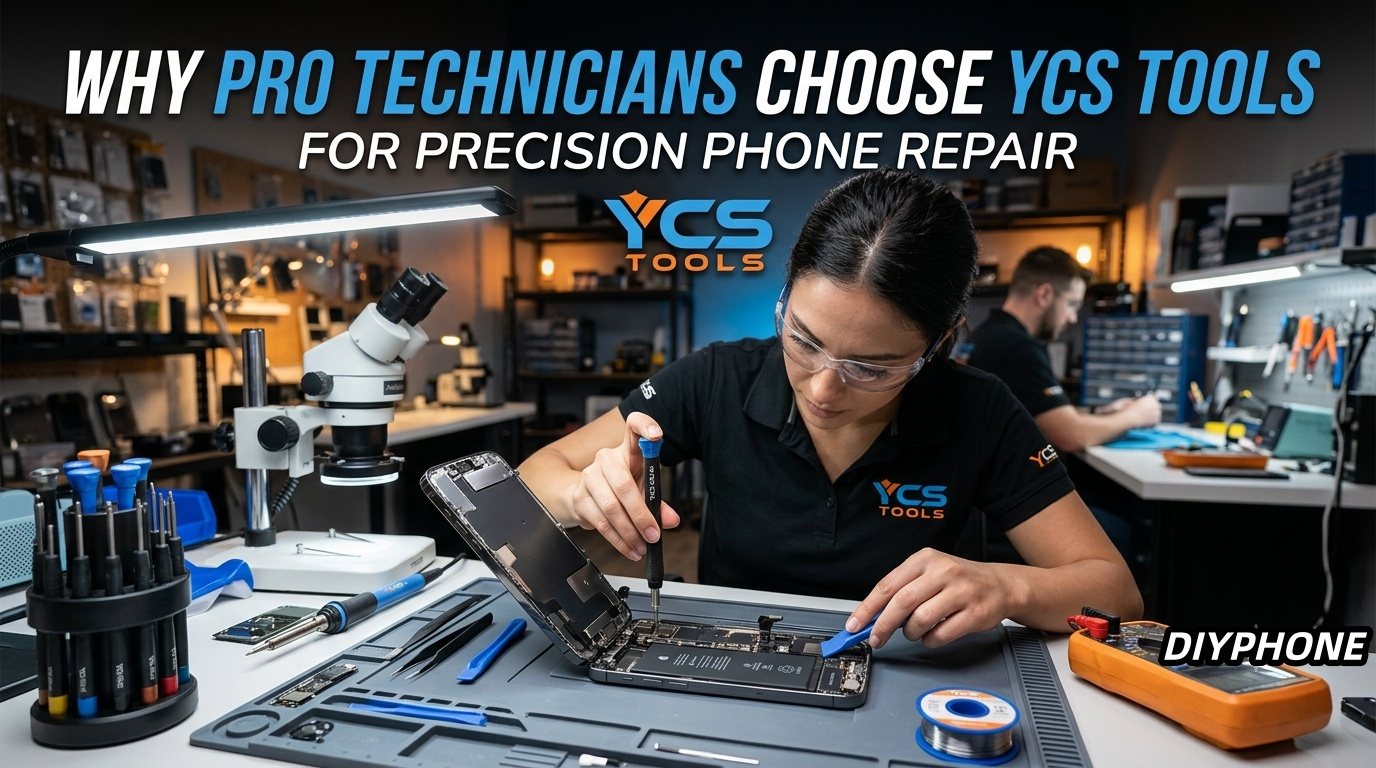
Due to the increasing sophistication of hardware in mobile phones and electronic products, there are higher requirements for the precision and stability of repair tools when they fail. As a professional brand in this field, the core of YCS Tools' product line design lies in assisting technicians to complete high-difficulty motherboard and screen repair tasks through standardized auxiliary equipment. we will analyze the functions and usage protocols of key repair tools by combining practical application scenarios.

I. Tool Application for Motherboard Repair
The difficulty of motherboard troubleshooting lies in its extreme precision; any improper operation during glue removal, disassembly, or soldering can lead to circuit fractures.
1. Chip Glue Removal and Disassembly
Chip repair typically involves critical components such as the CPU, NAND flash storage, and power management ICs, which are usually covered with robust cured glue.
· Fault Analysis and Preparation: Before disassembly, technicians must use a microscope to locate the chip edges and analyze the coverage and hardness of the glue. For core logic areas like the CPU, it is strictly forbidden to use tweezers to forcibly pry, so as to avoid pulling out embedded vias within the PCB.
· Tool Application: The YCS intelligent electric grinding pen plays a core role here. Its high rotation speed and fine bits enable precise removal of the hard glue around the chip, effectively reducing physical stress. Coupled with a specialized IC disassembly blade set, technicians should maintain steady hand pressure to cut into the gap after heating the solder to its melting point with a hot air gun.
· Precautions: During the process, high-quality halogen-free flux must be used to ensure even heating of solder joints, preventing motherboard deformation caused by localized overheating.
2. Reballing Process Workflow
After removing the chip, cleaning the residual glue and old solder on the pads is the basic work, while BGA reballing is the core step that determines the success or failure of the repair.
· Operation Details: Use a high-precision reballing stencil, paired with a heat-resistant magnetic reballing pad, to ensure the chip pads and the stencil holes are perfectly aligned. Use a YCS heating plate to maintain a stable heating environment, allowing the solder balls to fill evenly and form full solder joints. For tiny pins, it is recommended to conduct a secondary check with a Trinocular Stereo Microscope to ensure there are no bridged or missing solder joints.

II. Precise Fault Detection
1. Short Circuits and Leakage
High current leakage in mobile phones is usually caused by capacitor breakdown or an internal short circuit in the power IC.
· Fault Analysis: Leakage points are often extremely small and difficult to detect with the naked eye. Blindly dismantling parts can easily cause damage to multiple areas of the motherboard.
· Tool Application: A multi-functional DC regulated power supply is the core equipment for this type of troubleshooting. By adjusting to a preset safe voltage, technicians can inject current into specific power supply circuits and use the principle of thermal conduction to make the shorted component heat up rapidly. At this point, combined with infrared thermal imaging technology or a simple rosin smoke method, the broken-down component can be precisely located.
· Charging Port Flex Cable Detection: Abnormalities in the charging path are common faults. The TNS360 charging port comprehensive tester can quickly lock abnormal circuit resistance in the charging port flex cable through integrated interface diagnostics, eliminating the need for cumbersome disassembly tests of the entire unit and greatly optimizing the diagnostic process.
2. Screen Repair Tools
· Screen Separation
a. Fault Analysis: When the screen glass is cracked but the LCD display is normal, only the outer glass cover needs to be replaced. The challenge lies in how to separate the broken glass from the OCA glue layer below while keeping the display flex cable intact.
b. Tool Application: Using a YCS visual screen separation mold allows the module to be firmly locked. Through precise pressure balance adjustment, it is ensured that the display screen is not damaged by squeezing during the separation process. Combined with specialized glue remover and cutting wire, residual glass can be handled smoothly and efficiently, laying the foundation for subsequent OCA lamination.
· Auxiliary Tools
a. Operation Platform: The YCS Shenlong Arc Pad is a heat-resistant, strong magnetic pad. Its main function is not only insulation but, more importantly, standardizing the precision operation area. The magnetic suction area can standardize the storage of every tiny screw, avoiding secondary faults caused by loss.
b. Wire Handling: When performing jumper wire repairs on PCB boards, high-performance high-temperature YCS Jumper Wire and micro solder wick are indispensable. These consumables must possess excellent electrical conductivity and temperature resistance to ensure that the repaired circuit connections can withstand prolonged current loads.

III. Synergy of Tools and Technology
The reason why YCS tools enjoy high recognition in the repair industry is not only because of the durability and precision of their hardware but also because they have built a technical sharing closed loop for tool application through the role of technician YCS Yang.
1. Knowledge Dissemination Drives Tool Application
On platforms such as Instagram and TikTok, the YCS team breaks down complex repair logic into standardized operation steps by releasing detailed case videos. This teaching method ensures that technicians are not just buying products, but also learning a validated standardized operating procedure. For example, disassembling the latest electronic products and explaining how to use a microscope for tiny pad repair—these technical details are widely disseminated through videos.
2. Upgrading of the Repair Industry
At the industry level, the professional-grade tools provided by YCS enable independent repair shops to undertake more high-value tasks:
· Service Upgrading: Moving from simple module replacements, such as screens and batteries, to chip repairs, such as motherboard capacity expansion, data recovery, and logic layer repair. This not only increases the profit margin of a single shop but also enhances the repair shop's ability to handle complex faults.
· Talent Cultivation: The intelligent design of modern tools effectively lowers the technical threshold. After systematic training, junior repair personnel can use these tools to achieve more standardized and stable repair results, thereby establishing a professional advantage in market competition.
IV. Conclusion and Suggestions
In summary, for technicians dedicated to improving their technical level, configuring a set of precise, reliable, and affordable Phone repair tools makes YCS undoubtedly a good choice. Acquiring genuine YCS tools through professional channels like Phonefix, combined with standardized technical training, can ensure greater repair capabilities and more stable repair work when facing various mobile devices failures.


