
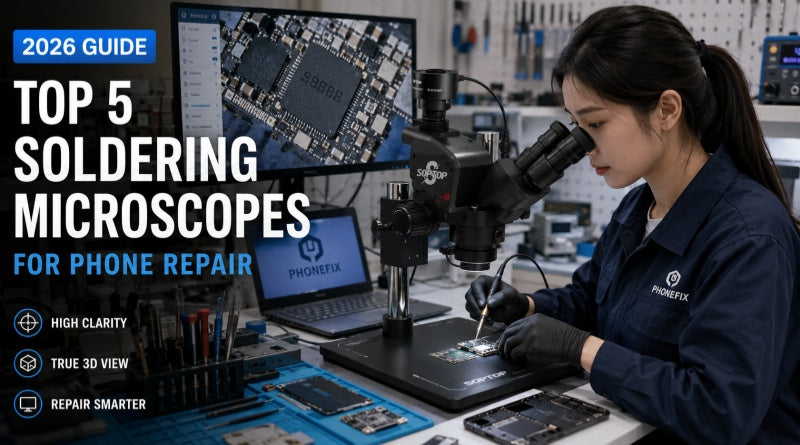
In 2026, the market for phone repair microscopes is primarily divided into two categories: optical stereo microscopes and digital microscopes. Optical microscopes offer true 3D depth perception, making them ideal for chip soldering and precision tasks; digital microscopes support high-definition displays, video recording, and multi-viewer capabilities, making them better suited for teaching, live streaming, and documenting repairs. Below are five recommended professional microscopes for phone repair, PCB soldering, and chip-level repair.

I. Top 5 Recommended Soldering Microscopes for Phone Repair (2026)
1. SOPTOP 7-60X Ultra-HD Trinocular Stereo Microscope (with 4K Camera)
· Type: Trinocular optical stereo microscope
· Magnification: 7X–60X continuous zoom
· Target Users: Professional phone repair shops, high-end micro-soldering experts, and those requiring teaching/recording capabilities
· Why It’s Recommended: This SOPTOP microscope is a benchmark in the field of professional micro-soldering. Featuring superior optical lenses, it offers continuous zoom from 7X to 60X and delivers true 3D depth perception with a strong sense of spatial depth—crucial for accurately positioning tiny motherboard components and performing jumper wire repairs. Even more impressive is its trinocular port equipped with a 4K HD camera; this allows technicians to maintain a precise 3D view through the eyepieces while simultaneously outputting ultra-clear 4K repair footage to a large external screen, greatly facilitating recording, demonstrations, and client communication.
2. YCS MR.YANG 85 Ultra-HD Electronic PCB Soldering & Repair Microscope
· Type: Integrated HD optical/digital microscope
· Magnification: Ultra-HD zoom with long working distance
· Target Users: Professional electronics repair engineers seeking ultimate image quality and ample workspace
· Why It’s Recommended: Designed with input from renowned industry experts, the YCS microscope is purpose-built for electronics PCB and phone chip-level repair. It delivers exceptional clarity and color accuracy, precisely revealing burn marks, broken traces, or cold solder joints on logic boards. Crucially, it features spatial optimization specifically designed for soldering tasks, providing a generous working distance beneath the lens. This gives technicians ample room to maneuver soldering irons, hot air guns, and tweezers simultaneously, significantly reducing the risk of tools accidentally bumping into the lens.
3. PHONEFIX 4K HDMI/USB Industrial Digital Video Microscope
· Type: Digital HDMI video microscope
· Magnification: Up to 130X (with professional industrial lens)
· Target Users: Technicians who frequently inspect motherboards for extended periods and wish to eliminate eye strain caused by traditional eyepieces.
· Why It’s Recommended: This all-digital solution from PHONEFIX utilizes a top-tier 4K industrial camera sensor and outputs directly to a monitor via HDMI or USB. It is an ideal alternative for technicians who dislike traditional eyepieces or suffer from neck strain due to prolonged downward viewing. Its standard high-resolution 130X lens clearly magnifies individual BGA pins, while its plug-and-play digital operation and robust photo/video capabilities make it a cornerstone of modern digital repair workshops.

4. AmScope 3.5X-90X Trinocular Stereo Boom-Arm Microscope (SM-6TZ-80S-9M)
· Type: Trinocular optical stereo microscope
· Magnification: 3.5X – 90X continuous zoom
· Target Users: Professional repair shops and technicians performing intensive micro-soldering.
· Why It’s Recommended: This classic, heavy-duty boom-arm stereo microscope from AmScope is renowned in the industry. It offers a wide continuous zoom range and features a heavy, sturdy dual-arm articulated boom stand. This design allows technicians to extend the microscope over a wide area and lock it at any angle across the workbench. When not in use, it can simply be pushed aside to free up valuable desk space, making it perfect for complex micro-soldering tasks on multi-layer motherboards found in smartphones, tablets, and laptops.
5. Andonstar AD407 3D HDMI Digital Microscope
· Type: Portable all-in-one digital microscope
· Magnification: Up to 270X (on a 7-inch screen)
· Target Audience: Small-to-medium repair shops and individual engineers on a budget who prioritize fatigue-free digital viewing.
· Why We Recommend It: The Andonstar AD407 stands out in the digital microscope market thanks to its built-in 7-inch adjustable LCD screen and unique "3D" visual effect. It strikes a perfect balance between cost and practicality, offering a long working distance and smooth imagery without the need for complex, expensive optical lens assemblies. Real-time video can be transmitted to a large external monitor with minimal latency, making it an excellent value choice for freelancers or beginners entering the field of high-definition mobile phone micro-soldering.
II. Key Considerations When Buying a Mobile Phone Repair Microscope
When selecting the ideal microscope for your repair workstation, consider the following core specifications:
1. Working Distance
Mobile phone repair requires the simultaneous use of tools such as soldering irons, hot air guns, and tweezers; therefore, the microscope must provide sufficient working distance.
Recommended features:
· Working distance of 100mm or more.
· Ample clearance space beneath the lens.
· Capability to accommodate large PCBs.

2. Optical Microscope vs. Digital Microscope?
Each type has its own advantages:
| Microscope Type | Key Advantages | Best Use Cases |
| Optical Stereo Microscope | Real 3D depth perception, zero latency, more precise hand-eye coordination | IC soldering, BGA repair, precision jumper wire work |
| Digital Microscope | Large screen HD display, eliminates eye strain, convenient video/photo recording | Fault diagnostics, training/teaching, live-streamed repairs |
Professional repair technicians often prefer optical microscopes, whereas trainers and content creators tend to favor digital microscopes.
3. The Importance of a Trinocular Design
A trinocular microscope allows for:
· Binocular viewing of repair details.
· Connecting an external camera for recording.
· Displaying the repair process on a large screen.
For professional repair shops, a trinocular design boosts efficiency and facilitates the creation of instructional content.
In summary, the right microscope for you depends on your budget, daily repair volume, and personal preference regarding screens versus eyepieces. Whether you are repairing iPhone motherboards, Android devices, or performing PCB chip-level repairs, choosing the Professional phone repair tool helps technicians complete every task with greater precision and efficiency.


