
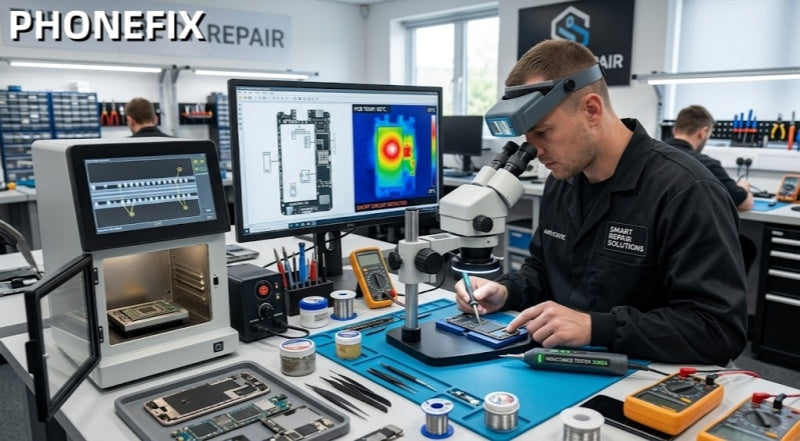
A smartphone won't power on, yet shows no water damage or screen issues? Traditional motherboard repair often relies on experience and trial-and-error. With modern components as small as 0.3mm, inaccurate diagnosis can waste time and damage the board. Here are three smart diagnostic tools that improve repair accuracy and efficiency in 2026.
I. Thermal Imaging Camera
· Core Advantage: Instantly pinpoints PCB short circuits and micro-leakage currents.
· Representative Models: QianLi L256, Thermal Master P3
1. Working Principle and Core Diagnostics
All circuit faults—such as capacitor shorts, IC leakage, or damaged power rails—generate abnormal thermal signals. A thermal imaging camera can convert this heat into real-time color images without ever needing to physically contact the motherboard; overheating components will appear in red or yellow hues.
· Micro-Leakage Detection: The Thermal Master P3 features a 512×384 sensor capable of detecting faint leakage currents as low as 1 mA—a method far safer and more efficient than traditional multimeter-based "burn-in" testing.
· Precise Localization: The QianLi L256 boasts a high resolution of 256×192 and supports dual-mode switching between thermal Imaging Camera and visible light, allowing technicians to directly cross-reference the heat source against a schematic bitmap or the physical board itself.

2. Typical Scenario: A short circuit in a tiny 0201-sized capacitor located near a charging IC. While traditional troubleshooting might take hours, a thermal imaging camera can pinpoint the exact location within just two minutes.
II. BGA X-Ray Inspector
· Core Advantage: Non-destructive, non-disassembly internal inspection of multi-layer motherboards and BGA solder joints.
· Applicable Scenarios: Advanced hardware repair, layer-by-layer troubleshooting of "sandwich-style" motherboards, and high-value data recovery.
1. Why Do Phone Repair Shops Need an X-Ray Machine?
Since the release of the iPhone X, mainstream flagship smartphones have widely adopted a "sandwich-style" dual-layer motherboard structure. When a phone is subjected to severe drops or thermal stress, the solder balls located beneath BGA chips—such as the CPU and baseband processor—are highly susceptible to cracking (resulting in cold joints), open circuits, or bridging (short circuits). These faults often leave no visible external damage and cannot be detected using standard multimeters or thermal cameras.
The BGA X-ray machine is currently the only device capable of non-destructively imaging the internal layers beneath a chip. It can clearly reveal:
· Solder ball bridging or cold joints beneath BGA chips.
· Broken internal traces within the mid-layer board caused by severe drops or bending.
· Quality control verification following BGA reballing and soldering procedures.

2. Commercial Value: Although the initial investment in this equipment is significant, taking on complex projects—such as data recovery from phones that have died following a severe drop or suffered physical board damage—can generate a single-case revenue ranging from $200 to $600. This serves as a crucial "technical moat" for high-end repair shops.
III. Portable Inductance Tester
· Core Advantages: Exceptional cost-effectiveness; rapid 60-second power circuit inspection.
· Representative Models: ZORZA, DIYPHONE
1. Why is it a standard fixture at every repair workstation?
Inductors (coils) are critical components situated around the Power Management IC (PMIC) on a mobile phone motherboard. If an inductor suffers from a cold joint or internal damage, the phone may exhibit symptoms such as high current draw without booting, failure to charge, or loss of signal.
· Non-destructive Rapid Testing: Traditional multimeters struggle to accurately measure inductance while the component remains *in situ* (on the board). With a dedicated inductance tester, you simply touch the probes to the two terminals of the inductor; a green light indicates it is functioning normally, while a lack of illumination signifies damage—eliminating the need to use a hot air gun for component removal.
· Low Cost, High Return: These portable tools are priced between just $10 and $30, are powered via a Type-C port, and offer true "plug-and-play" simplicity.

2. Workflow Optimization: In modern Android and iPhone devices, 30% to 40% of "failure-to-boot" faults are directly caused by damaged power inductors associated with the PMIC. Before utilizing a heat gun or thermal imager, performing a quick 60-second preliminary scan with an inductance tester can significantly reduce diagnostic costs.
IV. Efficient Mobile Phone Motherboard Diagnostic Workflow
| Smart Tool | Best Applications | Diagnostic Time | Technical Barrier |
| Inductance Tester | No Boot, No Power Response, PMIC Power Rail Inspection | < 2 Minutes | Beginner (Plug & Play) |
| Thermal Camera | PCB Leakage, Short Circuits, IC Overheating | 1 to 5 Minutes | Intermediate (Requires Schematics/Bitmap) |
| BGA X-Ray Machine | Sandwich Board Faults, Hidden BGA Cracks, VIP Data Recovery | 5 to 15 Minutes | Advanced (Master-Level Repair) |
These three tools collectively address the core requirements of board-level fault diagnosis. An inductance tester enables rapid detection of power-related faults; an infrared thermal imager allows for contactless identification of current leakage and thermal anomalies; and an X-ray machine facilitates the detection of hidden internal damage. When used in combination, these tools significantly enhance diagnostic efficiency and accuracy, making them indispensable professional instruments for modern mobile phone motherboard repair.


