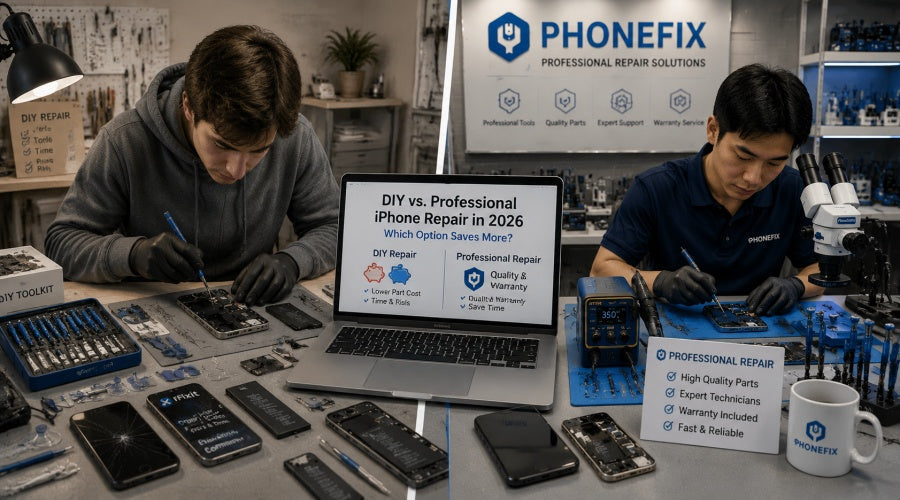
By 2026, smartphones have become an essential part of daily life, yet repair issues—such as cracked screens and aging batteries—remain increasingly common. Faced with high repair costs, users often hesitate between DIY repairs and professional services. This article analyzes which approach is the better choice by examining costs, risks, and the actual user experience.

I. The 2026 iPhone Repair Market Landscape and Key Options
After years of evolution, the iPhone repair market by 2026 has developed a highly segmented and tiered service ecosystem. When facing a malfunction, users generally have two main categories of choices, comprising four specific sub-options:
1. DIY Repair Ecosystem
Users purchase parts and specialized toolkits from online platforms or official Apple channels, then disassemble the device and replace faulty components themselves by following video or illustrated professional tutorials.
· Apple Official Self Service Repair: Apple provides genuine parts and rentable professional-grade toolkits (including heavy-duty heating presses, Screen Heating Separator, etc.), ensuring 100% compatibility and system certification, though the overall cost is relatively high.
· Third-Party Independent DIY Market: Leveraging platforms like iFixit and Injured Gadgets, as well as mature electronics supply chains, users can access a wide range of options—from cost-effective aftermarket parts to genuine parts salvaged from other devices—along with more lightweight and portable toolkits.
2. Professional Repair Service Ecosystem
· Apple Store / Apple Authorized Service Providers (AASPs): These strictly use OEM (original) parts and follow standardized technical procedures; repairs preserve official warranty and AppleCare+ coverage. However, service fees for out-of-warranty repairs are the highest in the market.
· Independent Third-Party Repair Shops: These offer highly flexible pricing and a wide selection of parts—ranging from genuine salvaged components and high-quality aftermarket parts to budget-friendly alternatives. With efficient service, they are ideal for users on a budget whose devices are out of warranty.
· Mobile On-Site Repair: Technicians bring professional equipment directly to the user's location for on-site disassembly and repair, offering great convenience, though this usually incurs a premium for the on-site service.
II. Cost Analysis: Unveiling the Real Figures Behind the Price Tag
When evaluating repair costs, one must not look solely at the purchase price of parts; instead, a "total cost" approach is required—one that factors in hidden costs such as tool investments, consumables, time and effort, and risk premiums.
1. Breakdown of DIY Repair Costs
· Parts Procurement: Market prices vary significantly. For screen replacements, third-party aftermarket screens range from $30 to $150, whereas genuine screens from Apple’s Self Service Repair program cost between $200 and $350. Regarding batteries, high-quality third-party options cost around $15–$40, while official genuine batteries are priced at approximately $70–$90.
· Investment in Tools and Supplies: First-time DIYers must invest in basic tools. A starter kit—including a precision screwdriver set, heating pad, suction cup, and anti-static pry tool—costs $10–$30; however, if the repair involves professional-grade modules or micro-soldering, equipment costs can exceed $100. Additionally, hidden consumables such as waterproof screen adhesive strips, thread-locking fluid, and isopropyl alcohol for cleaning add a fixed cost of $5–$20 per repair.
· Time and Learning Costs: For a beginner, a standard screen or battery replacement—including studying tutorials, watching videos, and performing the actual repair—typically requires 2 to 4 hours of active time.

2. Price Comparison of Professional Repair Services
· Official/Authorized Repair Costs: Without insurance, screen replacement typically costs $200–$400, and battery replacement costs $80–$100 (with AppleCare+, the service fee is just $29 for screen repair and $99 for other damage).
· Third-Party Independent Repair Shop Costs: Screen replacement averages $80–$200, and battery replacement costs $40–$70. Repairs usually take only 30 minutes to 2 hours, and most reputable shops offer warranties ranging from 30 days to a lifetime guarantee.
III. Risk Assessment: Potential Pitfalls and Hidden Costs of DIY Repair
While DIY repair may appear attractive due to the lower upfront cost of parts, the highly integrated nature of smartphone internals entails significant technical risks. Attempting repairs yourself can easily lead to a situation where "saving a little money" results in a much larger expense:
1. Warranty Voidance and Component Pairing Restrictions
Unauthorized disassembly completely voids the device's official limited warranty. Furthermore, iOS employs strict component pairing verification for core internal parts. Using uncertified third-party components or failing to perform official system pairing can easily result in the loss of True Tone functionality, complete failure of Face ID, or persistent "Unable to Verify Genuine Part" pop-up warnings in Settings.
2. Risk of Secondary Damage Due to Handling Errors
· Battery Safety Hazards: Using a metal pry tool to remove the battery risks puncturing the soft-pack cell, which can easily cause a short circuit, overheating, or even a fire;
· Ribbon Cable Damage: Improper force control when lifting the screen or separating sensors can easily snap fragile ribbon cables for the touchscreen or ambient light sensor;
· Motherboard "Long Screw Damage": iPhones contain a wide variety of screws of differing lengths. Confusing their locations and forcing a long screw into a hole intended for a short screw can pierce the motherboard's printed circuitry, rendering the device completely irreparable;
· Loss of Sealing Integrity: Uneven application of waterproof adhesive strips or failure to thoroughly remove old adhesive will cause the phone to completely lose its water and dust resistance.
IV. Decision Framework: Choosing the Best Repair Option for You
To help users make informed decisions that best serve their financial interests, we can evaluate options based on factors such as device value, fault type, warranty status, and personal technical ability. Below is a comparison matrix featuring quantitative analysis and recommended solutions:
Summary of Repair Decision Matrix:
| Evaluation Dimension | Recommended for DIY Repair | Recommended for Professional Repair |
| Residual Device Value |
Older models with residual value below $200 (e.g., iPhone 11 and earlier) |
Recent flagship models valued over $500 (e.g., iPhone 15 / 16 series) |
| Fault & Component Type |
Modular, easily replaceable parts (e.g., simple battery degradation, standard screen replacement) |
Logic board micro-soldering, liquid damage restoration, laser back glass separation, Face ID module repair |
| Warranty & Insurance Status | Device is fully out of warranty, without AppleCare+ coverage | Device is under official warranty or covered by active AppleCare+ |
| Technical Proficiency | Experienced with precision electronics, adept with spudgers and screwdrivers | Lacks hands-on experience, prioritizes efficiency, high success rate, and repair warranty |
Overall, both DIY repair and professional repair have their respective advantages. For minor issues or repairs on older devices, DIY not only cuts costs but also hones your repair skills; however, for high-value equipment and complex faults, professional services better ensure safety and efficiency. Regardless of the approach you choose, backing up data, assessing risks, and taking steps to extend the device's lifespan are always wise moves. If you plan to perform DIY mobile phone repairs, visit China Phonefix to select high-quality phone repair tools, parts, and professional equipment that make the repair process more efficient, precise, and reliable.