
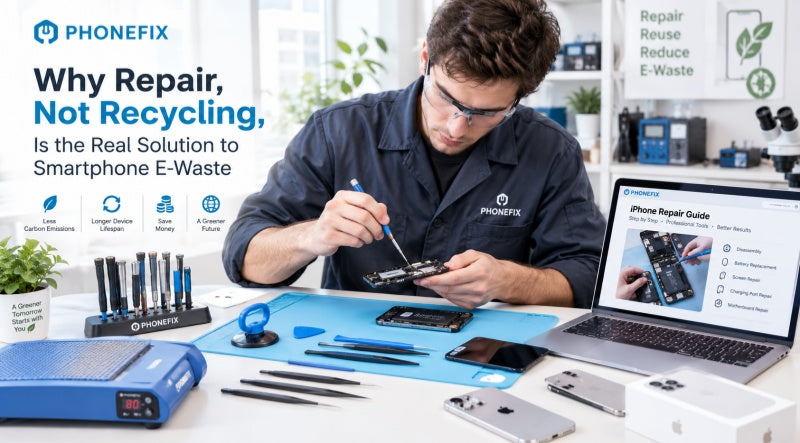
In an era of rapid product turnover, the hundreds of millions of mobile phones discarded annually have triggered a severe e-waste crisis. While many instinctively view "recycling" as the best eco-friendly choice, research from the World Economic Forum (WEF) suggests that repair—not recycling—is the primary solution for addressing e-waste. Extending the lifespan of a smartphone not only lessens the environmental burden but also empowers consumers to reshape their consumption habits toward sustainability through DIY repairs.
I. The Shocking Truth: Manufacturing Creates 85–95% of Emissions
Many people assume that the primary environmental damage caused by a smartphone occurs during its daily use. However, data from the World Economic Forum reveals that 85% to 95% of a smartphone’s total carbon footprint is generated during the "manufacturing phase" alone.
Although recycling can recover some raw materials, the global e-waste recycling rate has hovered at only around 17% in recent years. Furthermore, the energy required to smelt and reprocess recycled materials is far greater than the energy needed to keep an existing device running. Extending the lifespan of a smartphone from three to four years—a 33% increase—would reduce annual carbon emissions by an amount equivalent to taking hundreds of thousands of cars off the road.

II. Fighting Planned Obsolescence & Toxic Waste
Smartphones account for nearly 10% of the world’s total e-waste. When phones are sent to landfills, hazardous substances such as mercury, lead, and cadmium can leach into the groundwater and soil, causing long-term toxic contamination. Many manufacturers design their devices with "closed" architectures, making it extremely difficult to replace individual phone components. A degraded battery or a loose charging port is often enough to spell the "death" of a device that otherwise remains perfectly functional.
This is precisely why the global "Right to Repair" movement and the community of DIY enthusiasts have emerged. With the right tutorials and professional tools, replacing a battery or fixing a screen is not only entirely feasible but also a rewarding experience—all while saving a significant amount of money.
III. Gear Up for the Circular Economy: Essential Tools for DIY Fixers
You don’t need a degree in electronic engineering to repair your own phone—all you need is patience, a detailed tutorial, and a set of professional-grade repair tools. At China Phonefix, we provide tech enthusiasts and everyday consumers with precise, reliable repair tools, enabling you to safely disassemble and fix your smartphone without damaging its delicate internal components.
1. Precision Screwdriver Sets
Modern smartphones frequently use tamper-resistant, miniature screws (such as Apple’s Pentalobe and Y-type screws). Using a standard household screwdriver will almost certainly cause the screw heads to strip. DIYFixTool’s high-quality precision screwdriver sets are perfectly tailored for major devices like the iPhone, Samsung Galaxy, and Google Pixel, ensuring that screws remain intact during disassembly.
2. Screen Heating Pads and Suction-Based Opening Tools
Before replacing a cracked screen or a battery, you must first soften the strong, water-resistant adhesive sealing the device. A dedicated LCD heating pad warms the glass evenly to a safe temperature; combined with a suction-cup clamp and ultra-thin opening picks, this allows you to cleanly separate the adhesive layers without causing damage.

3. Anti-Static (ESD) Tweezers and Precision Pry Tools
The interior of a smartphone is packed with tiny ribbon cables and fragile solder joints. Using ESD-safe tweezers and nylon pry tools allows you to safely disconnect battery connectors or handle miniature IC chips, effectively preventing damage from electrostatic discharge (ESD) or accidental short circuits.
4. Temperature-Controlled Soldering Stations (For Advanced Repairs)
For complex micro-soldering tasks—such as replacing a damaged USB-C charging port or repairing motherboard circuitry—a stable, temperature-controlled soldering station paired with a microscope can turn seemingly impossible repairs into manageable DIY projects.
Recycling should be a "last resort" for devices that truly cannot be saved, not the first option. The most eco-friendly smartphone is always the one you are currently using. By choosing to replace a battery, repair a cracked back glass, or swap out a charging port, you’re not just keeping precious metals out of landfills and reducing carbon emissions—you’re also saving a significant amount of money. Ready to take on your first DIY repair? Visit DIYFixTool.com to explore our full range of professional repair kits, replacement parts, and precision tools. Join the "Right to Repair" movement—we’re with you every step of the way!