
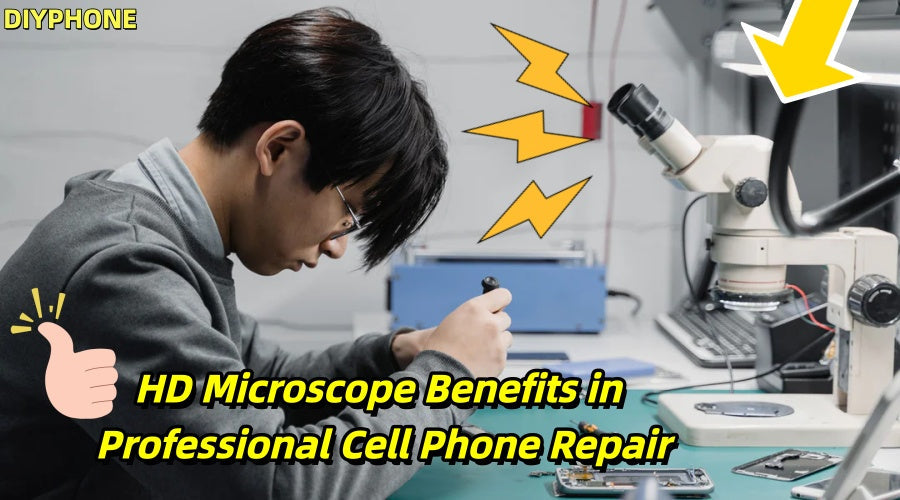
In the field of modern cell phone repair, technicians face the dense integration of motherboard components. In this context, high-definition microscopes are no longer exclusive to laboratories, but have become an indispensable repair tool in the hands of every technician pursuing professional service. DIYPHONE will explore how microscopes play a key role in modern precision repair with their advantages, and demonstrate their irreplaceable value in specific failure scenarios.

I. Core Advantages
The complexity of modern cell phone motherboards is beyond imagination. Tiny capacitors and inductors are even smaller than dust. When encountering such failures, the introduction of a microscope is essential.
1. Precise Diagnosis and Risk Assessment
Before using a heat gun or soldering iron, static inspection is the first step in determining repair success.
· Subtle Damage: Baseband circuit failures or repeated system restarts often stem from micro-cracks on the edges of IC chips invisible to the naked eye. Under high-magnification optical imaging, these invisible killers have nowhere to hide.
· Improved Quoting Accuracy: Only by seeing the failure clearly can the most reasonable quotation be given, avoiding rework or part loss caused by misjudgment, and significantly increasing customer trust.
2. Trinocular Stereo Microscope
Compared to traditional binocular equipment, it adds an independent optical interface. This innovation has changed the repair mode.
· Synchronous Monitoring and Teaching: By connecting a 4K Microscope Camera, technicians can observe through the eyepieces while transmitting real-time images to a large screen. This not only facilitates consultations among multiple people but also provides a direct first-person perspective for technical training.
· Digital Archiving: Comparison images before and after repair can be sent to customers as evidence. This transparency is key to building a reputation for modern professional repair shops.
3. Alleviating Occupational Fatigue
Long-term bowed-head operation is the main cause of cervical spondylosis in technicians. High-definition microscopes combined with ergonomic designs allow technicians to keep their spines straight and naturally gaze into the eyepieces, greatly reducing the physical burden brought by hours of soldering work.

II. Application Analysis in Specific Failures
To better understand the role of microscopes, we take two typical cell phone repair cases as examples to analyze their functional applications.
1. iPhone Logic Board Middle Layer Pad Repair
When dealing with double-layered motherboards (such as A16/A17 models), dropped pads or pseudo-soldering are common failures.
· Role of the Microscope: Under a field of view magnified more than 50 times, technicians can clearly observe the integrity of each BGA pad. If a pad is found to be detached, the microscope assists technicians in using 0.01mm ultra-fine jumpers for repair.
· Key Steps
Step1. Under the Trinocular Stereo Microscope, use a precision scraper to carefully scrape away the UV solder mask around the damaged area.
Step2. Use high-hardness precision tweezers to hold micron-level copper wire and precisely solder it onto the broken trace via microscope positioning.
Step3. Apply UV curing oil and ensure the coating accurately covers the jumper wire under microscope monitoring without interfering with surrounding pads.
2. Corrosion Cleaning After Liquid Damage
Water-damaged devices often face complex short-circuit problems.
· Role of the Microscope: Corrosion is usually hidden at the bottom of ICs or between tiny components. Microscopes help technicians locate those almost invisible white mold spots or blackened solder joints.
· Key Steps
Step1 First, perform a quick scan of the entire board at 6.5x magnification to locate obvious oxidation areas.
Step2 Target the damaged IC, increase the magnification, and use a fine-tip soldering iron to clean residual oxides, ensuring every pin is as bright as new to prevent secondary failures caused by residual corrosion.

III. Combination of Microscope and Auxiliary Tools
After the microscope is responsible for finding problems, the matching precision tools are responsible for solving them.
1. Core Supporting Tools
· 4K HD Industrial Camera: Captures the finest solder ball textures of the motherboard, providing high-definition image support for remote technical consultations.
· Precision Anti-static Tweezers (ESD): The tips are specially ground, making them a must-have companion for handling 0.1mm jumpers and moving micro ICs, while protecting sensitive components from static damage.
· Adjustable Brightness LED Ring Light: Eliminates visual blind spots. By adjusting the light angle, the trace layers and surface pads on the motherboard can be clearly distinguished.
2. Practical Tips to Enhance Efficiency
· Optimize Working Distance: When setting up the stand, sufficient vertical space should be left between the objective lens and the motherboard. It is recommended to install a 0.5x auxiliary objective lens (Barlow lens), which provides a wide field of view and frees up operation space for heat gun nozzles and soldering iron tips.
· Wide-angle First: Develop a habit of scanning the whole board at low magnification first, and then gradually magnifying target suspected points. This avoids "getting lost" in the microscopic field of view and ensures that damage to surrounding related circuits is not missed.
Conclusion
In today's era where cell phone repair is entering the age of tool technology, microscopes make blurred cracks clear and complex operations precise. Investing in a high-quality trinocular stereo microscope, combined with precision Cell phone repair tools, not only improves the success rate of repairs but also helps technicians better enhance their repair techniques.


